
About this guide
Condo insurance in Florida starts with one practical question: what does your condo association insure, and what are you still responsible for as the unit owner? Most Florida condo owners need to understand two insurance layers before comparing prices: the association master policy and the individual HO-6 condo policy.
Use this page as the main starting point before you request quotes, renew a policy, or buy a condo. It explains the complete Florida condo insurance framework, then points you to the more specific guides for HO-6 coverage, quote comparison, requirements, companies, city pages, and condo insurance before closing.
- Florida condo insurance usually involves both the association master policy and your own HO-6 unit-owner policy.
- The association policy and the unit-owner policy do not protect the same things.
- Florida law places certain interior property and insurance responsibility on the unit owner.
- HO-6 coverage may help with interior property, personal property, liability, loss of use, and certain loss assessment exposure.
- Flood insurance should be reviewed separately because standard condo insurance usually does not solve flood damage.
- The best quote depends on your association documents, lender requirements, unit details, deductible comfort, and ZIP code.
Already know you need Florida condo insurance? Compare HO-6 options by ZIP code, association requirements, personal property limits, loss assessment needs, flood exposure, and deductible preferences.
Compare Florida Condo Insurance Quotes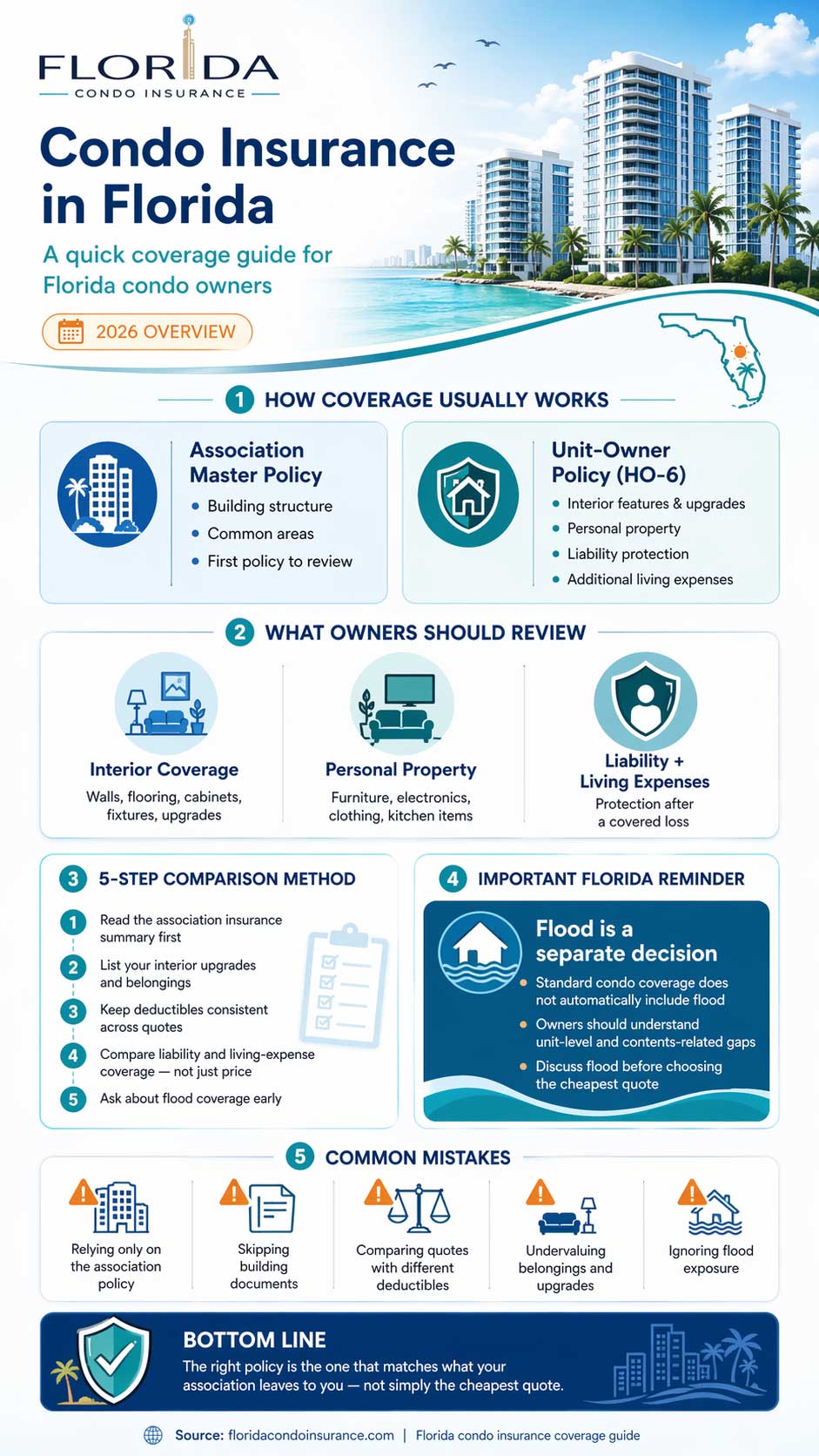
Start here: choose the right Florida condo insurance guide
This page is the statewide hub. Use it to understand the overall framework, then move to the page that matches your situation. That helps you avoid comparing quotes with missing documents, mismatched coverage limits, or assumptions that do not match your association master policy.
What comprehensive Florida condo insurance should mean
A comprehensive Florida condo insurance review does not mean one policy automatically covers every risk. It means the association master policy, the unit-owner HO-6 policy, flood exposure, loss assessment coverage, deductibles, lender instructions, and optional endorsements are reviewed together before you choose a quote.
This matters because the association and the unit owner usually insure different parts of the property. FLOIR describes HO-6 condo insurance as “walls-in” coverage for the interior of the structure, while the association master policy generally covers the exterior structure and common areas. HO-6 also usually does not cover flooding, so flood coverage should be treated as a separate review item. [1]
Who this Florida condo insurance guide is for
This guide is for Florida condo owners, buyers, and renewing policyholders who need the basic framework before choosing coverage. It is especially useful if you are not sure what your association covers, what you personally need to insure, whether flood insurance is separate, or how loss assessment coverage fits into a unit-owner policy.
You are buying a Florida condo
Use this guide to understand what documents to request before accepting an insurance quote or lender requirement.
See the closing checklistYou already own a condo
Use it to review whether your current HO-6 limits still match your unit, belongings, improvements, association deductible exposure, and flood questions.
You are comparing quotes
Use it to understand the coverage pieces first, then compare quotes with the same assumptions, limits, deductibles, and policy questions.
How condo insurance in Florida usually works
A Florida condo owner should usually think about insurance in two layers. The first layer is the condominium association’s master policy. The second layer is the unit owner’s individual HO-6 policy. The association’s policy may protect building-level property and common elements, but it does not automatically protect your belongings, liability, temporary living expenses, or every item inside your unit.
The Florida Office of Insurance Regulation describes HO-6 condo insurance as coverage often called “walls-in” coverage because it covers the interior of the structure while the condominium association’s master policy covers the exterior structure and common areas. FLOIR also states that HO-6 policies generally provide coverage for building property, personal property, personal liability, and loss of use, and that HO-6 usually does not cover flooding. [1]
What Florida law says about association and unit-owner responsibility
Florida Statute 718.111 says a condominium association must use its best efforts to obtain and maintain adequate property insurance for association property, common elements, and condominium property the association is required to insure. The statute also explains that association property insurance excludes personal property within the unit and certain interior items located within the unit and serving only that unit, including floor, wall, and ceiling coverings, electrical fixtures, appliances, water heaters, water filters, built-in cabinets, countertops, and window treatments. Those items and the insurance on them are the unit owner’s responsibility. [2]
Your association documents still matter. Florida law gives the broad insurance framework, but your declaration, bylaws, master policy, deductible schedule, and lender requirements help determine how much unit-owner coverage you should consider before asking for quotes.
What an HO-6 condo policy may cover
Citizens Property Insurance describes its Condominium Unit Owners policy as coverage for condominium-unit owners who live in the unit. Citizens explains that it covers certain features of the unit’s interior, personal property, additional living expenses, and liability coverage, but does not cover the exterior of the condominium building. [3]
Interior building property
This can include the interior items you are responsible for, such as flooring, built-ins, cabinets, countertops, fixtures, appliances, and improvements.
Personal property
Furniture, electronics, clothing, kitchen items, décor, and everyday belongings should be estimated realistically before choosing a contents limit.
Personal liability
Liability coverage may help if you are responsible for injury or property damage involving someone else.
Loss of use
Loss of use can help with additional living expenses if a covered loss makes your condo temporarily unlivable.
Florida condo insurance quote checklist
Before you compare Florida condo insurance quotes, prepare the same information for each quote request. This helps you compare policies fairly instead of choosing a lower premium that may have weaker limits, higher deductibles, or missing endorsements.
Use the same documents, limits, deductibles, occupancy details, and flood questions for every quote request. That makes it easier to compare real coverage value instead of choosing a lower premium that may leave important gaps.
Loss assessment coverage is a Florida condo detail worth reviewing
Loss assessment coverage matters because a condominium association may assess unit owners after certain shared losses or association-level deductibles. Florida Statute 627.714 states that residential condominium unit owner policies issued or renewed on or after July 1, 2010 must include at least $2,000 in property loss assessment coverage for qualifying assessments made as a result of the same direct loss to property, when the loss is of the type covered by the unit owner’s residential property insurance policy. [4]
- What loss assessment limit is included in the policy?
- Can the limit be increased beyond the minimum?
- Does it apply to association deductibles after a covered property loss?
- Is there a separate deductible for loss assessment coverage?
- Which assessments are excluded?
Flood insurance is separate from standard condo insurance
Flood is one of the biggest coverage questions for Florida condo owners because standard HO-6 coverage usually does not cover flooding. FloodSmart explains that homeowners in participating NFIP communities, including people who own condominiums and townhouses, can buy flood insurance. FloodSmart also states that building policies can cover up to $250,000 of flood damage and contents policies can cover up to $100,000 for belongings kept inside the home. [5]
FEMA’s condominium association materials explain that a Residential Condominium Building Association Policy, or RCBAP, is available to condominium associations to insure against direct physical flood damage to the building. FEMA also notes that associations should encourage individual unit owners to purchase contents or building coverage of their own to protect personal property or the unit against flood damage. [6]
- Does the association carry an RCBAP or another flood policy?
- Does the association’s flood policy protect only the building?
- Do you need contents flood coverage for your belongings?
- Does your lender require flood insurance?
- Are NFIP and private flood options available for your situation?
Documents to review before choosing coverage
A Florida condo insurance quote is only useful when it reflects the building and the unit. Before comparing options, gather the association’s certificate of insurance, master policy summary if available, declaration, bylaws, deductible information, lender requirements, and a basic list of interior upgrades and personal belongings.
Coverage limits to think about
There is no single correct coverage amount for every Florida condo. A renovated coastal unit with custom finishes may need a different HO-6 limit than a smaller inland unit with basic finishes. The better approach is to separate the policy into practical coverage areas and ask whether each one matches your real exposure.
Common Florida condo insurance mistakes
- Assuming the association’s master policy covers everything inside the unit.
- Choosing a cheap HO-6 policy without reviewing deductibles, limits, and exclusions.
- Forgetting to review loss assessment coverage.
- Assuming flood damage is covered by a standard condo policy.
- Not asking whether interior upgrades are properly covered.
- Choosing personal property limits without making a basic inventory.
- Ignoring lender requirements until closing or renewal.
- Comparing quotes that use different deductibles, limits, or coverage assumptions.
Where to go next
For a deeper policy-type explanation, review our Florida HO6 Insurance guide. If you are ready to compare pricing and policy details, use our Florida Condo Insurance Quotes page. If you are buying and need coverage before a closing date, see Condo Insurance Before Closing in Florida. For carrier research, visit our Florida Condo Insurance Companies guide.
For city-specific risks, use the local pages after you understand the statewide framework. A coastal Miami condo, a Tampa Bay unit, an Orlando-area condo, and a Jacksonville condo may raise different flood, wind, building-age, association, and lender questions.
FAQ: condo insurance in Florida
Is condo insurance required in Florida?
Florida law, association documents, and lender requirements can all affect the answer. Even when a unit owner is not required in the same way as another owner, HO-6 coverage can still be important for interior property, belongings, liability, loss of use, and loss assessment exposure.
Does my condo association’s policy cover my unit?
The association policy may cover building-level property and common elements, but it usually does not cover your personal belongings, liability, loss of use, or many interior items serving only your unit. Review the association documents before setting your HO-6 limits.
Does HO-6 condo insurance cover flood damage?
Standard HO-6 coverage usually does not cover flood damage. Flood insurance should be reviewed separately through NFIP or private flood options where available, and condo owners should ask whether the association carries building flood coverage.
What is loss assessment coverage?
Loss assessment coverage can help when a condo association assesses unit owners after certain covered property losses. Florida requires qualifying unit-owner residential property policies to include at least $2,000 in property loss assessment coverage, but some owners may want to ask about higher limits.
What should I review before comparing quotes?
Review your association certificate of insurance, declaration, bylaws, master policy deductible information, lender requirements, interior upgrades, personal property estimate, flood exposure, and loss assessment needs.
What if I need condo insurance before closing?
Start early by requesting the association certificate of insurance, master policy details, deductible information, lender instructions, and flood-zone requirements. If your closing date is close, use the dedicated closing checklist before choosing a quote.
Bottom line
Condo insurance in Florida should start with the basic split between the association master policy and the unit-owner HO-6 policy. Once you understand what the association insures, what you are responsible for inside the unit, what your belongings are worth, whether loss assessment coverage is strong enough, and whether flood insurance needs separate attention, you can compare quotes with much better context.
Compare Florida condo insurance quotes using the same deductibles, limits, personal property assumptions, flood questions, and loss assessment needs.
Compare Florida Condo Insurance QuotesReferences
- Florida Office of Insurance Regulation, “Homeowners Insurance.” Source · ↩
- Florida Statutes, Section 718.111, “The association — Insurance.” Source · ↩
- Citizens Property Insurance Corporation, “Personal Policies — Condominium Unit Owners.” Source · ↩
- Florida Statutes, Section 627.714, “Residential condominium unit owner coverage; loss assessment coverage required.” Source · ↩
- FEMA FloodSmart, “What you need to know about buying flood insurance.” Source · ↩
- FEMA National Flood Insurance Program, “Flood Insurance for Condominium Associations.” Source · ↩