
About this review
Florida condo insurance shopping gets easier when you separate what is driven by your location from what is driven by your building documents and unit features. Condo owners in Florida often need an HO-6 policy to help protect personal property, personal liability, and interior items that may not be fully covered by the association’s master policy.[1][2] Florida law also places responsibility for many interior finishes and certain property inside the unit on the owner rather than the association, which is one reason comparing condo insurance by city can be useful before you request quotes.[2][3]
This page is designed to help you compare the factors that can change from one Florida market to another, then move toward the next step: choosing a policy structure that fits your condo, your association documents, and your budget. Property insurance rates may use location factors such as city, county, and ZIP code to establish territory, so where your condo is located can affect how you shop and compare quotes.[1]
Compare Florida Condo Insurance Quotes
Use this page to understand what may change by city, then move to a quote page built for Florida condo shoppers. Comparing quotes works better when you already know what your association covers, what your unit needs, and whether flood or loss-assessment protection deserves a closer look.
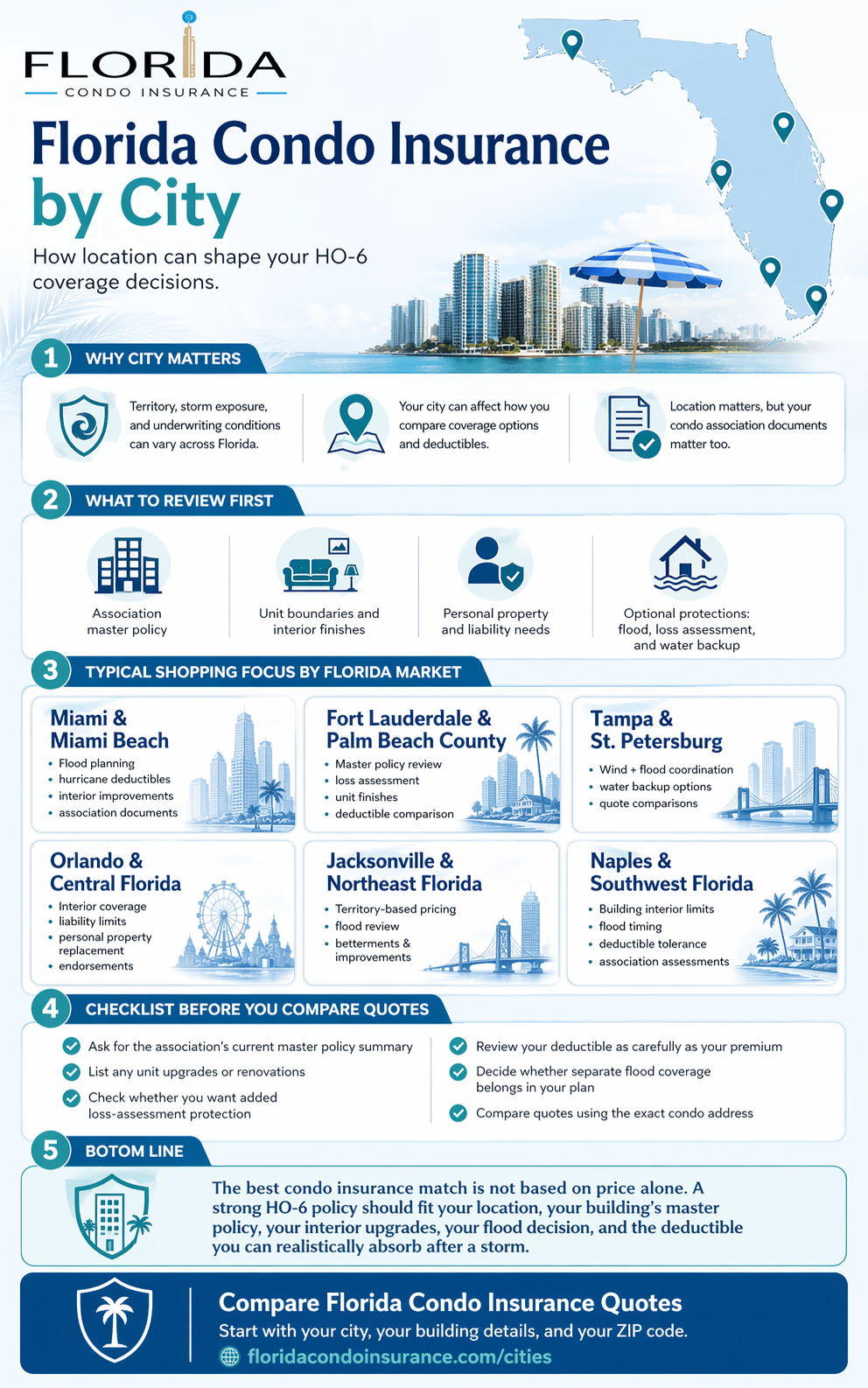
The same condo layout can shop differently from one Florida market to another because territory, storm exposure, and underwriting conditions are not identical statewide.[1]
Start with the association’s master policy, your unit boundaries, your interior upgrades, and whether you want extra protection for loss assessment, water backup, or flood.[2][4][5]
Compare your city-level location concerns with your building documents before you request quotes. That usually produces more useful comparisons than shopping by price alone.
Quick links before you compare cities
If you want the fundamentals first, start with our guide to condo insurance in Florida, then review our page on Florida HO-6 insurance. When you are ready to compare offers, go straight to Florida condo insurance quotes. You can also learn more about us or contact us if you want help comparing options.
How location changes the condo insurance conversation
The table below is not a rate sheet and it is not a promise of premium. It is a practical way to compare what deserves extra attention in different Florida markets before you choose an HO-6 policy or request a quote. Florida DFS notes that property insurance base rates can use city, county, and ZIP code to establish territory.[1]
What to compare before choosing a city-specific condo insurance quote
A strong condo quote is not simply the cheapest one. It should match the building’s insurance setup, your personal property, the upgrades inside your unit, and the amount of risk you are actually willing to keep after a loss.
City-by-city shopping checklist
- Ask for the association’s current master policy summary before you compare quotes.
- List any unit upgrades such as flooring, cabinets, countertops, built-ins, appliances, or bathroom remodels.
- Check whether you want extra loss-assessment protection.
- Review your deductible with the same attention you give the premium.
- Decide whether flood coverage should be part of your plan now rather than after a storm is already approaching.[5]
- Compare quotes using the exact condo address, not just a nearby ZIP or a general city estimate.[1]
Use your city research to choose a better quote
Once you know what may matter in your market, the next move is comparing quotes with the right questions in hand. This is where knowing your master policy, unit improvements, deductible comfort level, and flood plan can help you avoid weak comparisons.
Popular Florida condo markets to expand from this hub
This page also works as a city hub for future expansion. These are strong directions for location-based condo insurance content because each one supports a different buyer conversation before the quote stage.
Miami Condo Insurance
Useful for content focused on flood planning, hurricane deductibles, and association-document review.
Tampa Condo Insurance
A strong market for explaining Gulf exposure, flood options, and loss assessment.
Orlando Condo Insurance
A good fit for inland shoppers comparing location factors with building-document realities.
Jacksonville Condo Insurance
Helpful for explaining territory, flood review, and unit-improvement limits.
Bottom line
The best Florida condo insurance policy is not the same in every city, and it is not determined by price alone. A good match depends on your location, your building’s master policy, the upgrades inside your unit, your flood decision, and the deductible you can realistically absorb after a storm.[1][2][5][6]
Before you request quotes, confirm what the association insures and what your HO-6 policy needs to cover. That single step can make city-by-city comparison much more accurate and much more useful.
See Florida Condo Insurance Quote Options
If you already know your city, your building setup, and the protections you want to compare, move to our quote page and review options built around Florida condo insurance shoppers.
Get a QuoteReferences
- Florida Department of Financial Services, Homeowners Insurance Overview. Back to content ↑
- The 2025 Florida Statutes, Section 718.111. Back to content ↑
- Florida Department of Financial Services, Homeowners Insurance Toolkit. Back to content ↑
- Insurance Information Institute, Insuring a Co-op or Condo. Back to content ↑
- FEMA, Flood Insurance. Back to content ↑
- Insurance Information Institute, Homeowners Policy for Hurricane Deductibles. Back to content ↑
Florida Condo Insurance Editorial Team
Our editorial team creates consumer-focused Florida condo insurance content built around official state guidance, insurance education resources, and practical quote-comparison advice for condo owners and buyers.
Learn more about us or contact us with questions.