
About this review
Florida condo insurance quotes can look simple at first, but the lowest price is not always the safest choice. A cheaper quote may use higher deductibles, lower personal property limits, weaker loss assessment coverage, actual cash value instead of replacement cost, or no separate flood discussion. The better quote is the one that fits your condo association’s master policy, your unit-owner responsibilities, your belongings, your lender requirements, and your Florida-specific storm and water risk.
A strong quote comparison starts before you enter a ZIP code. Florida condo owners should review the association insurance certificate, understand what the individual HO-6 policy is expected to cover, estimate interior improvements and personal property realistically, and ask how hurricane deductibles, flood exposure, water backup, liability, loss of use, and loss assessment are handled.
- Compare Florida condo insurance quotes using the same deductibles, limits, and coverage assumptions.
- Review the condo association master policy before deciding how much interior building coverage you need.
- Check personal property, liability, loss of use, loss assessment, water backup, and hurricane deductible details.
- Ask about flood insurance separately because standard condo insurance should not be treated as flood coverage.
- Compare actual cash value and replacement cost because this can change how much you receive after a covered claim.
Ready to compare Florida condo insurance quotes? Use the same ZIP code, condo-use details, association documents, deductible preferences, and flood questions for every quote so the price comparison is fair.
Start Comparing QuotesChoose the right quote path before you compare
Different Florida condo owners need different quote conversations. A buyer close to closing may care most about lender proof and association documents. A renewal shopper may care more about deductibles, loss assessment, and whether the new quote is cheaper because it removes protection. Use the path below to decide what to check before accepting a quote.
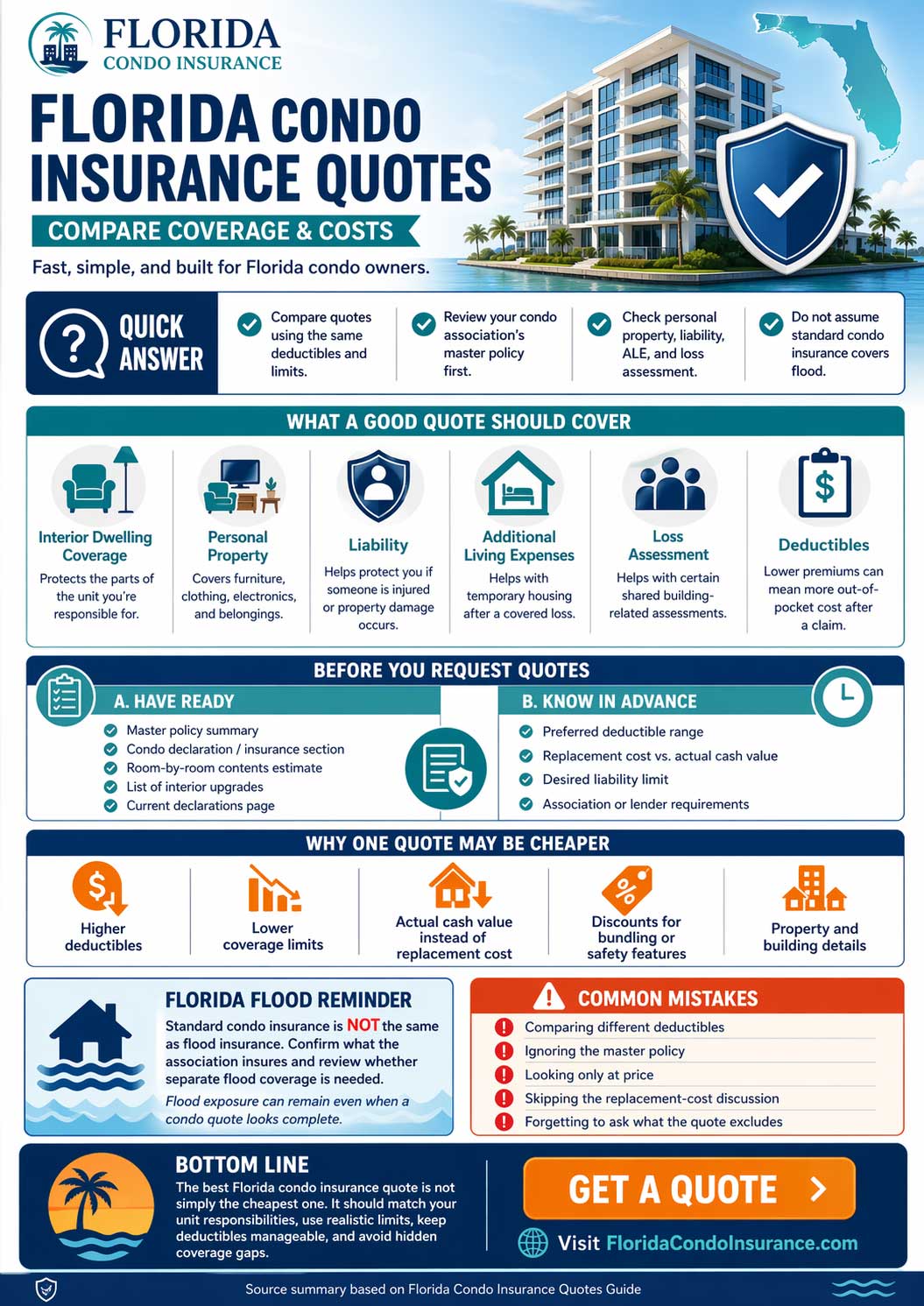
Treat every Florida condo insurance quote as a coverage proposal, not just a price. The safest comparison uses the same deductible strategy, similar personal property limits, comparable liability coverage, realistic interior coverage, clear loss assessment protection, and a separate flood insurance conversation.
Review the Quote ChecklistWhat Florida condo insurance quotes should help you compare
A Florida condo insurance quote is not just a price. It is a coverage proposal. The Florida Office of Insurance Regulation explains that HO-6 condo insurance is commonly referred to as “walls-in” coverage because it covers the interior of the structure, while the condo association’s master policy generally covers the exterior structure and common areas. FLOIR also states that HO-6 policies generally provide building property, personal property, personal liability, and loss of use coverage. [1]
That means a quote should be judged by what it includes, not only by what it costs. Two quotes can have similar monthly or annual premiums but very different protection. One may include stronger personal property coverage, higher liability limits, more useful loss assessment coverage, or better endorsements. Another may look cheaper because it uses a higher deductible or lower limits than your condo actually needs.
Start with the condo association policy before you trust the quote
A Florida condo quote is much more accurate when it is built around the association’s insurance responsibilities. Florida Statute 718.111 requires condominium associations to use their best efforts to obtain and maintain adequate property insurance for the association property, common elements, and condominium property the association must insure. The same statute excludes certain property inside the unit, including personal property, floor, wall and ceiling coverings, electrical fixtures, appliances, water heaters, built-in cabinets, countertops, and window treatments that are located within the unit and serve only that unit. The statute says that property and the insurance on it are the responsibility of the unit owner. [2]
Ask for these documents
- Association insurance certificate
- Master policy summary if available
- Condo declaration and bylaws
- Association deductible information
- Lender or closing insurance requirements
Estimate these items
- Flooring and wall finishes
- Cabinets and countertops
- Fixtures and appliances
- Furniture and electronics
- Clothing, décor, and daily-use items
Decide before comparing
- Preferred deductible range
- Replacement cost preference
- Liability limit target
- Loss assessment comfort level
- Whether flood needs separate coverage
Why one Florida condo quote can be cheaper than another
A cheaper quote is not automatically a better quote. The NAIC explains that actual cash value coverage considers age, wear and tear, and depreciation, while replacement cost coverage can be more useful when you need to repair or replace covered property. The NAIC also advises consumers to understand deductibles because a higher deductible may lower the premium but can create a larger out-of-pocket cost after a loss. [3]
Hurricane deductibles deserve special attention in Florida
Florida condo owners should not compare quotes without checking the hurricane deductible. The Florida Department of Financial Services explains that insurance companies must offer hurricane deductible options of $500, 2%, 5%, or 10% of the policy dwelling or structure limits, unless the percentage deductible is less than $500. The hurricane deductible must also be shown as a dollar amount, even when it is listed as a percentage. [4]
- Is the hurricane deductible a flat amount or a percentage?
- What is the actual dollar amount I would pay after a covered hurricane loss?
- Does the quote also have a separate all-other-perils deductible?
- Would a lower deductible be available at a higher premium?
- Does the deductible fit my emergency savings and closing budget?
Loss assessment can change the value of a quote
Loss assessment coverage is one of the quote details Florida condo owners should not skip. Florida Statute 627.714 requires residential condominium unit owner policies issued or renewed on or after July 1, 2010 to include at least $2,000 in property loss assessment coverage for qualifying assessments made as a result of the same direct loss to property, when the loss is of the type covered by the unit owner’s residential property insurance policy. The statute also states that a deductible of no more than $250 per direct property loss applies to that required coverage. [5]
The legal minimum is not automatically the best amount for every condo building. A condo association may carry large deductibles or face shared repair expenses after a covered loss. When comparing quotes, ask whether higher loss assessment limits are available, whether the policy has a separate deductible, and whether association deductible assessments are treated differently from other assessments.
- What loss assessment limit is included in the quote?
- Can I increase the limit?
- Is there a deductible for loss assessment coverage?
- Does it apply to association deductibles after a covered property loss?
- Which assessments are excluded?
Flood insurance should be quoted separately
A Florida condo quote can look complete and still leave flood exposure unresolved. FloodSmart explains that homeowners in participating NFIP communities, including people who own condominiums and townhouses, can buy flood insurance. FloodSmart also states that building policies can cover up to $250,000 of flood damage and contents policies can cover up to $100,000 for belongings kept inside the home. [6]
- Do not assume a standard HO-6 condo policy includes flood coverage.
- Ask whether the association carries flood coverage for the building.
- Ask whether you need contents flood coverage for your belongings.
- Check whether your lender requires flood insurance before closing.
- Compare NFIP and private flood options if available in your situation.
If you are buying a condo, compare quotes before closing
Many buyers wait until the last minute to look at condo insurance, but the better time to compare quotes is before the closing package is final. Your lender, title company, or condo association may ask for proof of coverage, and the quote may depend on details you do not have in front of you unless you request them early.
How to compare two Florida condo insurance quotes side by side
The cleanest way to compare quotes is to normalize the details first. That means you compare Quote A and Quote B with similar deductibles, similar coverage limits, similar personal property treatment, similar liability limits, and the same flood assumption. Once the coverage is aligned, the premium comparison becomes more meaningful.
- Match the all-other-perils deductible across each quote.
- Compare hurricane, wind, or percentage deductibles separately.
- Use the same personal property estimate for every quote.
- Check whether belongings are quoted at replacement cost or actual cash value.
- Compare liability and loss of use limits side by side.
- Compare loss assessment coverage and available upgrades.
- Confirm whether water backup or similar endorsements are included.
- Handle flood as a separate quote question, not as an assumption.
What information insurers may ask for
A condo insurance quote is only as accurate as the information behind it. If you do not know your association’s insurance setup, your deductible comfort level, or the value of your belongings and improvements, the quote may default to assumptions that do not match your unit.
When a cheap quote may be a warning sign
A cheap Florida condo insurance quote is not automatically bad, but it deserves a closer look. The quote may be reasonable if you have a simple unit, limited belongings, strong association coverage, and a deductible you can comfortably pay. But it may also be thin if it leaves out endorsements, underestimates personal property, ignores flood, or assumes loss assessment limits that are too low for your building.
- The quote is much cheaper than the others, but the deductible is much higher.
- The personal property limit is a default number that does not match your belongings.
- The quote does not clearly show replacement cost or actual cash value treatment.
- Loss assessment coverage is only the minimum and no higher option is shown.
- Flood is not mentioned even though the unit may have flood exposure.
- Water backup, liability, and loss of use are not explained clearly.
- The quote does not reflect renovations or upgraded interior features.
Useful internal guides before you choose a quote
If you need the general coverage framework first, review our Condo Insurance in Florida guide. If you want a deeper explanation of unit-owner coverage, use our Florida HO6 Insurance page. If you are preparing for a purchase or lender review, continue with our Condo Insurance Before Closing in Florida guide.
Price-focused shoppers can compare quote tradeoffs in our Cheapest Condo Insurance in Florida guide, while value-focused shoppers can review broader options in our Best Condo Insurance in Florida guide. If you need to understand lender, association, or owner-responsibility questions, use our Florida Condo Insurance Requirements page.
Owners in coastal or high-density markets should also consider city-specific context. For example, our Miami Condo Insurance guide explains why local flood, storm-surge, high-rise, and association deductible questions can matter before choosing a policy. If you want to compare insurer types and availability, review our Florida Condo Insurance Companies guide.
Compare Florida condo insurance quotes with the same limits, deductibles, personal property assumptions, association details, and flood questions so you can see which option actually offers better value.
Start Comparing Condo Insurance QuotesFAQ: Florida condo insurance quotes
How many Florida condo insurance quotes should I compare?
Comparing at least a few quotes can help you see whether the premium, deductible, personal property limit, liability limit, and loss assessment coverage are reasonable. The key is to compare similar limits and deductibles rather than only comparing the final price.
Why are Florida condo insurance quotes so different?
Quotes can differ because of deductibles, personal property limits, replacement cost options, building age, location, association insurance details, loss assessment coverage, liability limits, prior claims, and available endorsements.
Does a Florida condo insurance quote include flood insurance?
Usually, flood should be reviewed separately. Standard condo coverage should not be treated as flood insurance. Ask whether the association has building flood coverage and whether you need separate contents or unit-level flood protection.
What is the most important number in a condo quote?
The premium matters, but it is not the only important number. Review the deductible, interior building coverage, personal property limit, liability limit, loss of use limit, loss assessment coverage, and any flood-related quote separately.
Can I lower my condo insurance quote?
You may be able to lower the premium by adjusting deductibles, reviewing discounts, bundling where available, correcting inaccurate property information, or comparing companies. Avoid lowering the price by removing coverage you actually need.
Should I choose actual cash value or replacement cost?
Replacement cost may cost more, but it can provide stronger protection because it does not treat belongings the same way as depreciated actual cash value. Ask the agent how each quote treats personal property and whether replacement cost is available.
Do I need condo insurance before closing in Florida?
Many buyers need proof of insurance before closing, especially when a lender is involved. Ask your lender, title company, or association what documents are required, then compare quotes early enough to fix any coverage gaps before the closing date.
Bottom line
The best Florida condo insurance quote is not simply the cheapest one. It is the quote that fits your actual unit responsibilities, uses realistic personal property and interior coverage limits, keeps deductibles within reach, explains loss assessment clearly, and does not leave flood exposure hidden outside the conversation.
Before choosing a policy, compare quotes line by line. Make the coverage assumptions match first, then compare price. That gives you a much clearer view of which Florida condo insurance quote is truly better for your unit.
A quote is only useful when you understand what it includes, what it excludes, what deductible you would pay, and what separate coverage questions still need to be answered. Compare the details first, then decide whether the price is truly better.
Compare Florida Condo Insurance QuotesReferences
- Florida Office of Insurance Regulation, “Homeowners Insurance — HO-6 Condo Form.” Source · ↩
- Florida Statutes, Section 718.111, “The Association — Insurance.” Source · ↩
- National Association of Insurance Commissioners, “What’s the Difference Between Actual Cash Value Coverage and Replacement Cost Coverage?” Source · ↩
- Florida Department of Financial Services, “Florida’s Hurricane Deductible.” Source · ↩
- Florida Statutes, Section 627.714, “Residential Condominium Unit Owner Coverage; Loss Assessment Coverage Required.” Source · ↩
- FEMA FloodSmart, “What You Need to Know About Buying Flood Insurance.” Source · ↩