
About this review
Finding the cheapest condo insurance in Florida is not just about chasing the lowest monthly premium. A low-priced policy can still be a poor fit if it leaves major interior items, personal property, liability exposure, or loss-assessment risk on the owner. In Florida, condo owners usually need an HO-6 policy, and the right starting point is understanding what your association covers and what your individual policy needs to cover inside the unit.[1][2][3]
The smartest way to find cheaper rates is to compare real quotes, use the right deductible strategy, verify mitigation credits, and avoid paying for the wrong amount of coverage. Before price-shopping too hard, it helps to understand the broader structure of condo insurance in Florida so that “cheap” does not become “underinsured.”
Compare cheap condo insurance options the right way
Lower-cost condo insurance usually comes from better quote comparison, smarter deductibles, and matching coverage to your actual unit risk. Start with quotes that reflect your condo’s setup instead of relying on one generic price.
Deductible strategy
Coverage fit
A lower premium because of deductible choice, building details, mitigation credits, insurer appetite, or lower insured values that still make sense for the unit.[4]
Ignoring what the association policy excludes inside your unit, especially personal property and many interior finishes.[2]
Compare several insurers and treat sample rate tools as orientation only, because the official Florida rate tool says its displayed rates are illustrative rather than guaranteed premiums.[4]
What “cheap condo insurance” should really mean
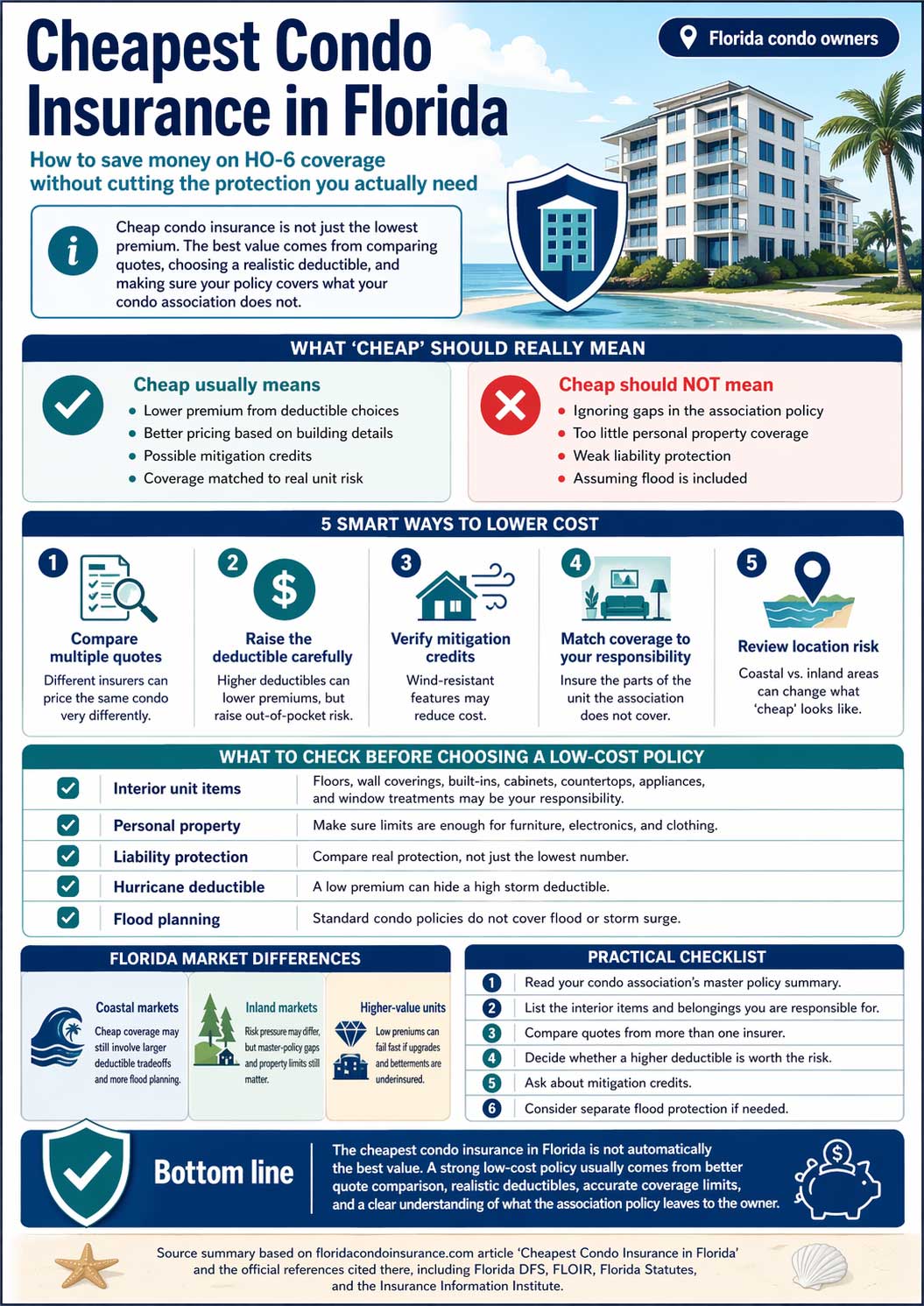
A strong low-cost policy is not just the cheapest premium you can find on the screen. It is a policy that gives you a sensible price for the protection you actually need. Florida DFS says condo owners need the Condominium Unit-Owners Form, commonly called HO-6, and FLOIR describes this as “walls-in” coverage that generally helps cover building property, personal property, personal liability, and loss of use.[1][3]
If you want a cleaner explanation of what HO-6 does before deciding how cheap is too cheap, review our guide to Florida HO-6 insurance.
The main ways to lower condo insurance cost in Florida
The Florida CHOICES tool says property insurance cost can vary based on geographic location, construction type, dwelling value, mitigation features, and deductibles. Those are the right levers to think about when trying to bring down cost without gutting coverage.[4]
The cheapest quote can become the most expensive mistake
Florida’s condo statute says the association policy must exclude personal property and many interior elements within the unit, including floor, wall, and ceiling coverings, electrical fixtures, appliances, built-in cabinets and countertops, and window treatments. That means an ultra-cheap policy can backfire if it leaves those items poorly protected.[2]
What to check before choosing a lower-cost condo policy
Cheap condo insurance is safest when you compare the structure of the policy rather than only the premium. The table below highlights the areas that often matter most.
Cheap condo insurance looks different by Florida market
Geographic location is one of the main drivers in the Florida rate-comparison framework, so a cheap quote in one part of the state may not translate directly to another. A condo owner in a more exposed coastal market may need to think differently about deductible tolerance, flood planning, and storm-related out-of-pocket risk than an owner in a less exposed inland market. If you want to compare how this conversation changes locally, use our Florida condo insurance by city hub.
Coastal markets
Cheaper may still involve bigger deductible tradeoffs and more flood planning.
Inland markets
Location pressure may differ, but master-policy gaps and property limits still matter.
Higher-value units
Low premiums can break down fast if upgrades and betterments are not insured properly.
A practical checklist for finding cheaper condo insurance without cutting the wrong corners
- Read your association’s master policy summary before comparing premiums.
- List the interior items, upgrades, and belongings you are actually responsible for.
- Compare more than one insurer and do not rely on a single advertised low rate.
- Review whether a higher deductible would save enough premium to justify the extra risk.
- Ask about mitigation credits instead of assuming they are automatically included.
- Check whether flood planning should be part of your strategy even if you are trying to save money overall.
Use quotes to find cheaper coverage that still makes sense
The best cheap condo insurance strategy usually starts with real quote comparison, not guesswork. Once you know what the association excludes and what deductible you can tolerate, lower-cost options become easier to judge.
Bottom line
The cheapest condo insurance in Florida is not automatically the best value. A strong low-cost policy usually comes from better quote comparison, realistic deductibles, accurate coverage limits, and a clear understanding of what the association policy leaves to the owner.[2][4]
For most condo owners, the smartest way to save money is to cut waste, not protection. That means finding a cheaper premium that still covers the risks you actually carry inside the unit.
References
- Florida Department of Financial Services, Homeowners Insurance Overview. Back to content ↑
- The 2025 Florida Statutes, Section 718.111. Back to content ↑
- Florida Office of Insurance Regulation, Homeowners Insurance. Back to content ↑
- Florida Office of Insurance Regulation, CHOICES Homeowners Rate Comparison Tool. Back to content ↑
- Insurance Information Institute, Hurricane Season Insurance Guide. Back to content ↑
- Insurance Information Institute, Hurricane Insurance FAQ. Back to content ↑
Florida Condo Insurance Editorial Team
Our editorial team creates Florida condo insurance content built around official state guidance, insurance education resources, and practical quote-comparison advice for condo owners and buyers.
Learn more about us or contact us with questions.