Category: Florida City Guides

  • Florida Condo Insurance by City: Compare HO-6 Coverage Across Florida

    Editorial Review
    FCI
    Florida Condo Insurance Editorial Team
    Created: April 20, 2026  |  Updated: April 20, 2026
    About this review
    This page was reviewed and rewritten for 2026 to help Florida condo owners compare city-related coverage differences, understand what an HO-6 policy may need to cover, and move more confidently toward quote comparison.

    Florida condo insurance shopping gets easier when you separate what is driven by your location from what is driven by your building documents and unit features. Condo owners in Florida often need an HO-6 policy to help protect personal property, personal liability, and interior items that may not be fully covered by the association’s master policy.[1][2] Florida law also places responsibility for many interior finishes and certain property inside the unit on the owner rather than the association, which is one reason comparing condo insurance by city can be useful before you request quotes.[2][3]

    This page is designed to help you compare the factors that can change from one Florida market to another, then move toward the next step: choosing a policy structure that fits your condo, your association documents, and your budget. Property insurance rates may use location factors such as city, county, and ZIP code to establish territory, so where your condo is located can affect how you shop and compare quotes.[1]

    $
    Get a Quote

    Compare Florida Condo Insurance Quotes

    Use this page to understand what may change by city, then move to a quote page built for Florida condo shoppers. Comparing quotes works better when you already know what your association covers, what your unit needs, and whether flood or loss-assessment protection deserves a closer look.

    City-sensitive shopping HO-6 guidance Florida-focused comparison
    Get My Quote
    Why city matters

    The same condo layout can shop differently from one Florida market to another because territory, storm exposure, and underwriting conditions are not identical statewide.[1]

    What to review first

    Start with the association’s master policy, your unit boundaries, your interior upgrades, and whether you want extra protection for loss assessment, water backup, or flood.[2][4][5]

    Best next step

    Compare your city-level location concerns with your building documents before you request quotes. That usually produces more useful comparisons than shopping by price alone.

    Quick links before you compare cities

    If you want the fundamentals first, start with our guide to condo insurance in Florida, then review our page on Florida HO-6 insurance. When you are ready to compare offers, go straight to Florida condo insurance quotes. You can also learn more about us or contact us if you want help comparing options.

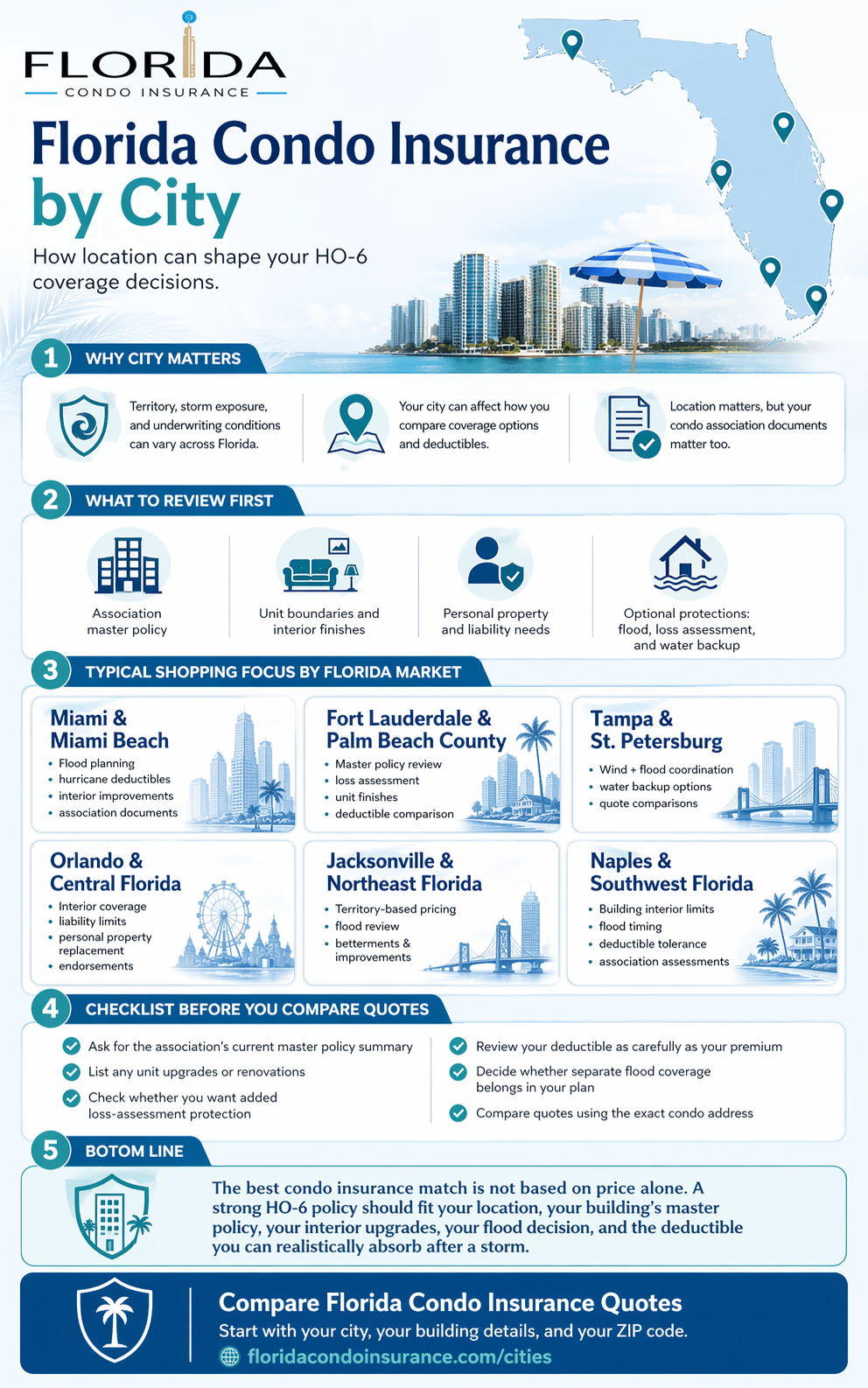
    Florida Condo Insurance by City infographic showing why location matters, what condo owners should review first, market focus areas for major Florida cities, and a checklist before comparing HO-6 quotes.

    How location changes the condo insurance conversation

    The table below is not a rate sheet and it is not a promise of premium. It is a practical way to compare what deserves extra attention in different Florida markets before you choose an HO-6 policy or request a quote. Florida DFS notes that property insurance base rates can use city, county, and ZIP code to establish territory.[1]

    Florida market Typical shopping focus Why it matters
    Miami & Miami Beach Flood planning, hurricane deductibles, interior improvements, association documents In coastal markets, owners usually need to pay especially close attention to flood decisions and deductible structure because standard condo coverage and flood coverage are not the same policy.[5][6]
    Fort Lauderdale & Palm Beach County Master policy review, loss assessment, unit finishes, deductible comparison In higher-value condo markets, it is smart to confirm whether your policy limit for interior items actually matches what is inside the unit, especially after upgrades or renovations.[2][3]
    Tampa & St. Petersburg Wind and flood coordination, water backup options, quote comparisons Gulf-area shoppers often benefit from checking both wind-related out-of-pocket costs and whether they want added protection that a standard condo policy may not include automatically.[4][5][6]
    Orlando & Central Florida Interior coverage, liability limits, personal property replacement, endorsements An inland address can still leave major questions about the master policy, personal property limits, and optional endorsements. Location matters, but the building documents still matter just as much.[1][4]
    Jacksonville & Northeast Florida Territory-based pricing, flood review, betterments and improvements Because location is one factor used to establish insurance territory, owners should compare quotes with the exact condo address and ask how interior improvements should be insured under the HO-6 policy.[1][3]
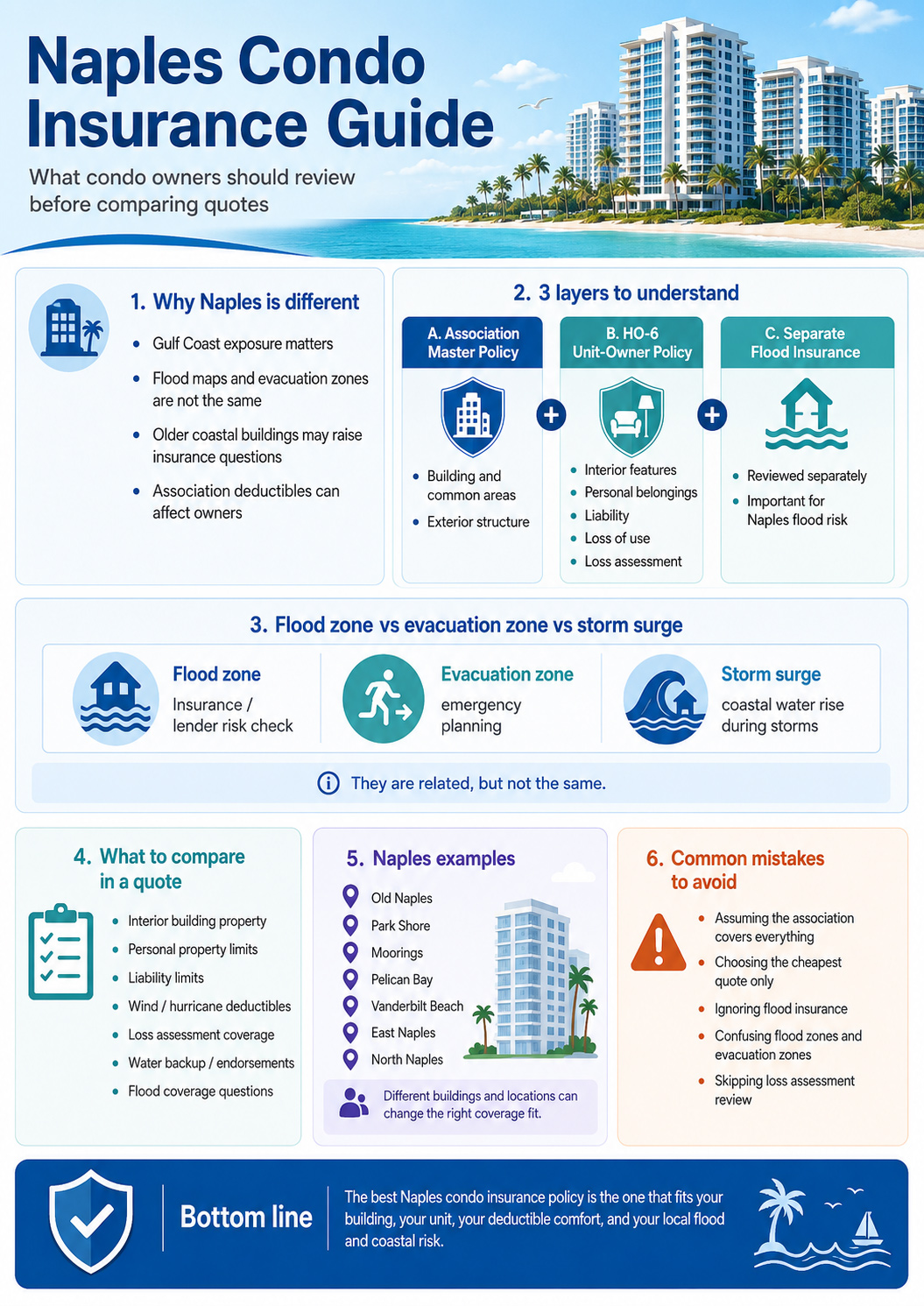
    Naples & Southwest Florida Building interior limits, flood timing, deductible tolerance, association assessments Where owners spend more on interior finishes, making sure the unit-owner policy matches actual improvements can be just as important as comparing the quote itself.[2][3][5]

    What to compare before choosing a city-specific condo insurance quote

    A strong condo quote is not simply the cheapest one. It should match the building’s insurance setup, your personal property, the upgrades inside your unit, and the amount of risk you are actually willing to keep after a loss.

    What to compare What to ask Why it matters
    Association master policy What exactly does the association insure, and what is excluded inside my unit? Florida law requires the association policy to exclude certain property inside the unit, so owners should not assume the building policy covers everything behind the walls.[2][3]
    Building property / improvements Do my cabinets, countertops, flooring, appliances, and improvements need more protection? Those are among the types of property Florida law says the association’s policy must exclude when they are inside the unit and serve only that unit.[2][3]
    Loss assessment How much protection do I have if the association assesses unit owners after a covered loss? Loss-assessment protection can matter when common areas are damaged and unit owners are charged a share of the cost after a covered event.[4]
    Flood coverage Do I need separate flood insurance, and if so, when should I buy it? Flood is separate from standard condo coverage, and NFIP policies typically have a 30-day waiting period unless a specific exception applies.[5]
    Hurricane deductible Is my hurricane deductible a flat dollar amount or a percentage? Hurricane deductibles are often percentage-based, which can materially change your out-of-pocket exposure after a storm.[6]
    Water backup and other endorsements Are there optional endorsements worth adding for my building and location? Some losses, including water backup situations, may require separate endorsement review instead of assumptions based only on the base policy.[4]

    City-by-city shopping checklist

    • Ask for the association’s current master policy summary before you compare quotes.
    • List any unit upgrades such as flooring, cabinets, countertops, built-ins, appliances, or bathroom remodels.
    • Check whether you want extra loss-assessment protection.
    • Review your deductible with the same attention you give the premium.
    • Decide whether flood coverage should be part of your plan now rather than after a storm is already approaching.[5]
    • Compare quotes using the exact condo address, not just a nearby ZIP or a general city estimate.[1]
    Ready to compare?

    Use your city research to choose a better quote

    Once you know what may matter in your market, the next move is comparing quotes with the right questions in hand. This is where knowing your master policy, unit improvements, deductible comfort level, and flood plan can help you avoid weak comparisons.

    Popular Florida condo markets to expand from this hub

    This page also works as a city hub for future expansion. These are strong directions for location-based condo insurance content because each one supports a different buyer conversation before the quote stage.

    Miami Condo Insurance

    Useful for content focused on flood planning, hurricane deductibles, and association-document review.

    Tampa Condo Insurance

    A strong market for explaining Gulf exposure, flood options, and loss assessment.

    Orlando Condo Insurance

    A good fit for inland shoppers comparing location factors with building-document realities.

    Jacksonville Condo Insurance

    Helpful for explaining territory, flood review, and unit-improvement limits.

    Bottom line

    The best Florida condo insurance policy is not the same in every city, and it is not determined by price alone. A good match depends on your location, your building’s master policy, the upgrades inside your unit, your flood decision, and the deductible you can realistically absorb after a storm.[1][2][5][6]

    Before you request quotes, confirm what the association insures and what your HO-6 policy needs to cover. That single step can make city-by-city comparison much more accurate and much more useful.

    Next step

    See Florida Condo Insurance Quote Options

    If you already know your city, your building setup, and the protections you want to compare, move to our quote page and review options built around Florida condo insurance shoppers.

    Get a Quote

    References

    1. Florida Department of Financial Services, Homeowners Insurance Overview. Back to content ↑
    2. The 2025 Florida Statutes, Section 718.111. Back to content ↑
    3. Florida Department of Financial Services, Homeowners Insurance Toolkit. Back to content ↑
    4. Insurance Information Institute, Insuring a Co-op or Condo. Back to content ↑
    5. FEMA, Flood Insurance. Back to content ↑
    6. Insurance Information Institute, Homeowners Policy for Hurricane Deductibles. Back to content ↑
    Author

    Florida Condo Insurance Editorial Team

    Our editorial team creates consumer-focused Florida condo insurance content built around official state guidance, insurance education resources, and practical quote-comparison advice for condo owners and buyers.

    Learn more about us or contact us with questions.

  • St. Petersburg Condo Insurance

    Editorial Review
    FCI
    Florida Condo Insurance Editorial Team
    Created: April 10, 2025  |  Updated: May 10, 2026
    About this review
    This page was reviewed and expanded for St. Petersburg condo owners, with added local flood and evacuation context, Florida HO-6 coverage details, association-versus-unit-owner responsibility, loss assessment guidance, flood insurance reminders, quote comparison steps, and common mistakes to avoid.

    St. Petersburg condo insurance should be reviewed as a local coverage decision, not just a quick price comparison. A condo owner usually relies on two different layers of protection: the condominium association’s master policy for the building and common elements, and the individual unit-owner policy, commonly called an HO-6 policy, for the parts of ownership that belong to the resident.

    In St. Petersburg, that decision can be shaped by flood-prone areas, evacuation zones, coastal and bayfront exposure, older buildings, association deductibles, interior upgrades, lender requirements, and how much risk the unit owner is willing to carry after a covered loss. The best policy is not automatically the cheapest quote. It is the quote that matches your building’s insurance setup, your personal property, your interior responsibility, your deductible comfort, your loss assessment exposure, and your separate flood insurance needs.

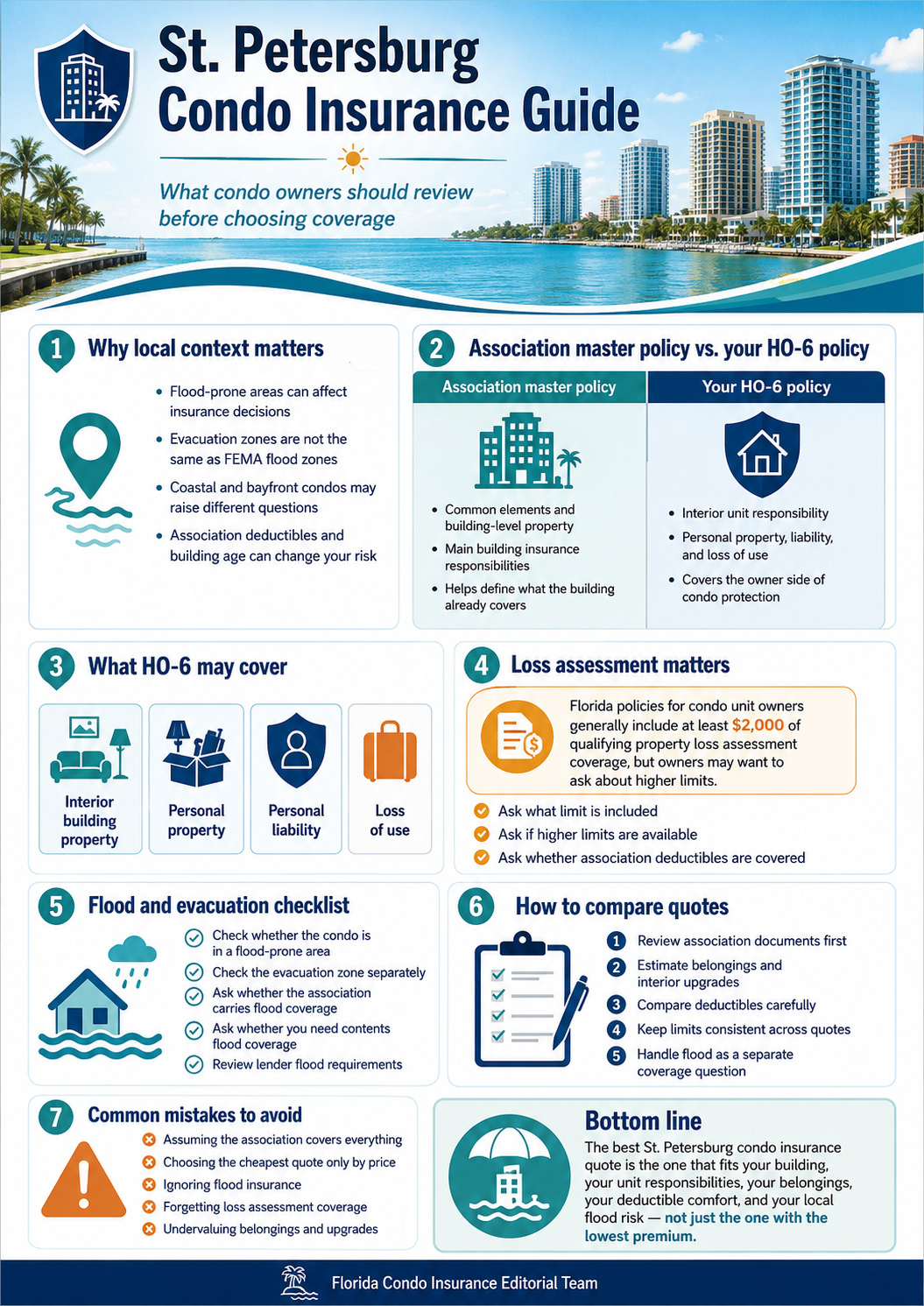
    Infographic explaining St. Petersburg condo insurance, including local flood and evacuation zones, association master policy, HO-6 coverage, loss assessment, flood insurance, quote comparison steps, and common mistakes for condo owners.
    Quick summary
    • St. Petersburg condo owners should review both the association master policy and their own HO-6 unit-owner policy.
    • Local flood risk and evacuation zones can affect the questions you should ask before choosing coverage.
    • HO-6 condo insurance usually focuses on the interior side of condo ownership, personal property, liability, and loss of use.
    • Loss assessment coverage matters because association deductibles and shared losses can affect individual owners.
    • Flood insurance should be reviewed separately because standard condo coverage usually does not solve flood exposure.

    Why St. Petersburg condo insurance needs a local review

    St. Petersburg is not a generic inland condo market. Condo buildings near Downtown St. Petersburg, the waterfront, Snell Isle, Shore Acres, Old Northeast, Isla del Sol, Tierra Verde, Gateway, and other Pinellas-area communities can raise different questions about flood exposure, evacuation planning, building age, association reserves, wind deductibles, and interior upgrades. The policy type may still be HO-6, but the coverage conversation can change from one building to another.

    The City of St. Petersburg tells residents to understand whether they live in a flood-prone area and to use the Prepare, St. Pete map to check evacuation zones and flood risk. Pinellas County also explains that an evacuation zone is not the same thing as a FEMA flood zone designation. That distinction matters because a condo owner can use local flood and evacuation information to ask better insurance questions before relying on one headline premium. [1] [2]

    Local factor Why it matters What to review
    Flood-prone location Flood exposure can affect lender requirements and whether separate flood coverage should be discussed. Prepare, St. Pete map, Pinellas flood tools, association flood policy, and lender requirements.
    Evacuation zone Evacuation zones are used for hurricane planning and are not the same as FEMA flood zones. Pinellas evacuation zone map and local hurricane planning guidance.
    Association deductible Shared deductibles or building-level losses may lead to owner assessments in some situations. Master policy, deductible schedule, reserve information, and loss assessment coverage.
    Interior upgrades Renovated flooring, cabinets, countertops, fixtures, and appliances can raise the amount you need to insure. Room-by-room inventory of finishes, upgrades, built-ins, and belongings.

    Association master policy vs. your HO-6 policy

    A St. Petersburg condo owner should not assume that the association’s insurance covers everything inside the unit. Florida Statute 718.111 says a condominium association must use its best efforts to obtain and maintain adequate property insurance for association property, common elements, and the condominium property the association is required to insure. The statute also excludes personal property within the unit and certain interior items such as floor, wall, and ceiling coverings, electrical fixtures, appliances, water heaters, built-in cabinets, countertops, and window treatments located within the unit and serving only that unit. Those items and the insurance on them are the unit owner’s responsibility. [3]

    Coverage layer Usually connected to St. Petersburg owner takeaway
    Association master policy Building property, common elements, and association-level responsibilities. Use it to understand what the building insures before setting your own HO-6 limits.
    HO-6 unit-owner policy Interior property, personal property, liability, loss of use, and owner-level risks. Use it to protect the part of condo ownership that belongs to you, not the association.
    Flood policy Flood damage to building property or contents, depending on the policy. Review separately because standard condo insurance usually does not cover flood damage.

    What HO-6 coverage may protect for St. Petersburg condo owners

    The Florida Office of Insurance Regulation describes HO-6 condo insurance as coverage for condominiums and notes that it is often called “walls-in” coverage because it covers the interior of the structure while the condo association’s master policy covers the exterior structure and common areas. FLOIR also says HO-6 policies generally provide coverage for building property, personal property, personal liability, and loss of use, and that HO-6 usually does not cover flooding. [4]

    Interior building property

    This can involve the interior features you are responsible for, such as flooring, cabinets, counters, fixtures, appliances, built-ins, and improvements.

    Personal property

    Furniture, electronics, clothing, décor, kitchen items, and everyday belongings should be estimated realistically before you choose a contents limit.

    Personal liability

    Liability coverage may help if you are responsible for injury or property damage involving someone else.

    Loss of use

    Loss of use can help with additional living expenses if a covered loss makes your condo temporarily unlivable.

    Loss assessment coverage deserves special attention

    Loss assessment coverage is especially important for condo owners because a condominium association may assess unit owners after certain shared losses or association-level deductibles. Florida Statute 627.714 states that unit owner residential property policies issued or renewed on or after July 1, 2010 must include at least $2,000 in property loss assessment coverage for qualifying assessments made as a result of the same direct loss to property, when the loss is of the type covered by the unit owner’s residential property insurance policy. [5]

    Loss assessment questions to ask
    • What loss assessment limit is included in the quote?
    • Can the limit be increased beyond the minimum?
    • Is there a separate deductible for loss assessment coverage?
    • Does it apply to association deductibles after a covered property loss?
    • Which assessments are excluded from the policy?

    Flood insurance and evacuation zones in St. Petersburg

    Flood insurance should be reviewed separately from a standard condo policy. FloodSmart explains that homeowners in participating NFIP communities, including people who own condominiums and townhouses, can buy flood insurance. FloodSmart also states that building policies can cover up to $250,000 of flood damage and contents policies can cover up to $100,000 for belongings kept inside the home. [6]

    St. Petersburg’s hurricane-planning guidance also says much of the Sunshine City lies in evacuation zones and tells residents to check their evacuation zone through the Prepare, St. Pete map. For condo owners, that information should not replace policy review, but it can help frame the conversation with an agent about flood, wind, evacuation planning, temporary living expenses, and building-level risk. [7]

    St. Petersburg flood and evacuation checklist
    • Check whether the address is in a flood-prone area.
    • Check the evacuation zone separately from the FEMA flood zone.
    • Ask whether the association carries flood coverage for the building.
    • Ask whether you need contents flood coverage for belongings inside the unit.
    • Review whether your lender requires flood insurance.
    • Compare loss of use coverage in case a covered event makes the unit temporarily unlivable.

    St. Petersburg building and neighborhood examples

    A St. Petersburg condo insurance quote should reflect the actual building, not only the city name. A bayfront high-rise, a downtown unit, an older building near established neighborhoods, a condo near Shore Acres, a waterfront property near Snell Isle, or a unit closer to Gulf beaches can raise different questions about flood, wind, building age, association deductibles, and interior improvements.

    Example situation Coverage question to ask
    Downtown or waterfront condo Does the quote account for building type, association deductibles, and flood discussion?
    Shore Acres or low-lying area Have flood zone, evacuation zone, and separate flood coverage been reviewed carefully?
    Older condo building Do building age, plumbing, electrical, roof, and association documents affect available quotes?
    Recently renovated unit Are upgraded floors, fixtures, cabinets, countertops, and appliances reflected in the coverage limit?
    Building with large association deductible Is loss assessment coverage strong enough for the building’s deductible and shared-loss risk?

    How to compare St. Petersburg condo insurance quotes

    The cleanest way to compare quotes is to keep the major assumptions consistent. A cheaper quote may simply have a higher deductible, lower personal property limit, lower liability limit, weaker loss assessment coverage, or no separate flood discussion. Once the limits, deductibles, and coverage assumptions are aligned, the premium comparison becomes more meaningful.

    Use this quote comparison method
    1. Start with the association documents before choosing your HO-6 limits.
    2. Estimate personal property and interior upgrades separately.
    3. Compare hurricane, wind, and all-other-perils deductibles carefully.
    4. Keep personal property and liability limits consistent across quotes.
    5. Ask about loss assessment coverage and available higher limits.
    6. Review water backup, loss of use, and other endorsements before comparing price.
    7. Handle flood insurance as a separate quote question.

    Documents to gather before you request a quote

    A St. Petersburg condo insurance quote is only as accurate as the information behind it. If you do not know what the association covers, what your lender requires, or how much your interior upgrades and belongings are worth, the quote may rely on assumptions that do not match your unit.

    Building documents

    • Association insurance certificate
    • Master policy summary if available
    • Condo declaration and bylaws
    • Deductible information
    • Reserve or assessment information if available

    Unit information

    • List of interior upgrades
    • Personal property estimate
    • Current declarations page if insured
    • Preferred deductible range
    • Lender insurance requirements

    Local risk checks

    • Flood-prone area review
    • Evacuation zone check
    • Association flood policy question
    • Separate contents flood discussion
    • Temporary living expense needs

    Common mistakes St. Petersburg condo owners should avoid

    • Assuming the association’s master policy covers everything inside the unit.
    • Choosing the cheapest quote without comparing deductibles and limits.
    • Ignoring flood insurance because the condo is not on the ground floor.
    • Confusing FEMA flood zones, storm surge areas, and evacuation zones.
    • Forgetting to review loss assessment coverage.
    • Undervaluing furniture, electronics, clothing, and interior upgrades.
    • Not checking whether belongings are covered at replacement cost or actual cash value.
    • Waiting until renewal week or closing week to request association documents.

    Useful next steps for Florida condo owners

    For a broader statewide explanation, review our Condo Insurance in Florida guide. For a deeper explanation of the policy type, use our Florida HO6 Insurance page. If you are ready to compare options, continue with our Florida Condo Insurance Quotes guide.

    Ready to compare?

    Compare St. Petersburg condo insurance with clearer coverage assumptions.

    Review your association policy, estimate your unit-level needs, and compare quotes with the same limits and deductibles before choosing coverage.

    FAQ: St. Petersburg condo insurance

    Is condo insurance required in St. Petersburg?

    Many condo owners need HO-6 coverage because of lender requirements, association documents, or practical financial protection. Even when a specific owner is not required in the same way as another owner, coverage can still be important for interior property, belongings, liability, loss of use, and loss assessment exposure.

    Does the association policy cover my St. Petersburg condo unit?

    The association policy may cover building-level property and common elements, but it usually does not cover your personal belongings, liability, temporary living expenses, or many interior items that serve only your unit. Review the association documents before setting your HO-6 limits.

    Does St. Petersburg condo insurance cover flood damage?

    Standard HO-6 condo insurance usually does not cover flood damage. St. Petersburg condo owners should review flood insurance separately, ask what the association carries for the building, and consider whether they need contents flood coverage.

    Are flood zones and evacuation zones the same thing?

    No. Pinellas County explains that an evacuation zone is not the same as a FEMA flood zone designation. Condo owners should check both because they answer different planning questions.

    What is loss assessment coverage?

    Loss assessment coverage can help when a condo association assesses owners after certain covered property losses. Florida requires qualifying unit owner residential property policies to include at least $2,000 of property loss assessment coverage, but some owners may want to ask about higher limits.

    How should I compare St. Petersburg condo insurance quotes?

    Compare quotes with the same deductible strategy, similar personal property limits, similar liability limits, the same replacement cost or actual cash value assumption, and a separate flood discussion. A lower premium is not useful if the coverage assumptions are weaker.

    Bottom line

    St. Petersburg condo insurance should be built around your actual building, your association’s insurance setup, your unit-level responsibilities, your belongings, your deductible comfort, and your local flood and evacuation context. The best quote is not simply the lowest premium. It is the policy that fits your real exposure and explains what is included, what is excluded, and what needs to be reviewed separately.

    Before choosing coverage, gather your association documents, estimate your interior upgrades and belongings, ask about loss assessment, and treat flood insurance as its own decision. That gives you a stronger basis for comparing St. Petersburg condo insurance quotes on value rather than price alone.

    References

    1. City of St. Petersburg, “Flooding.” Source ·
    2. Pinellas County Flood Map Service Center, “Evacuation Zone.” Source ·
    3. Florida Statutes, Section 718.111, “The association — Insurance.” Source ·
    4. Florida Office of Insurance Regulation, “Homeowners Insurance — HO-6 Condo Form.” Source ·
    5. Florida Statutes, Section 627.714, “Residential condominium unit owner coverage; loss assessment coverage required.” Source ·
    6. FEMA FloodSmart, “What you need to know about buying flood insurance.” Source ·
    7. City of St. Petersburg, “Hurricane Preparedness.” Source ·
  • Tampa Condo Insurance

    Editorial Review
    FCI
    Florida Condo Insurance Editorial Team
    Created: March 5, 2025  |  Updated: June 5, 2026
    About this review
    This page was reviewed and expanded for Tampa condo owners, with added local flood and evacuation context, Florida HO-6 coverage details, association-versus-unit-owner responsibility, loss assessment guidance, flood insurance reminders, quote comparison steps, and common mistakes to avoid.

    Tampa condo insurance should be reviewed as a local coverage decision, not just a quick price comparison. A condo owner usually relies on two different layers of protection: the condominium association’s master policy for the building and common elements, and the individual unit-owner policy, commonly called an HO-6 policy, for the parts of ownership that belong to the resident.

    In Tampa, that decision can be shaped by flood exposure, evacuation zones, Tampa Bay waterfront risk, older buildings, association deductibles, interior upgrades, lender requirements, and how much risk the unit owner is willing to carry after a covered loss. The best policy is not automatically the cheapest quote. It is the quote that matches your building’s insurance setup, your personal property, your interior responsibility, your deductible comfort, your loss assessment exposure, and your separate flood insurance needs. If you are comparing options now, treat Tampa as a building-specific quote decision rather than a generic Florida condo insurance search.

    Quick summary
    • Tampa condo owners should review both the association master policy and their own HO-6 unit-owner policy.
    • Flood zones and evacuation zones answer different questions and should both be checked before choosing coverage.
    • HO-6 condo insurance usually focuses on the interior side of condo ownership, personal property, liability, and loss of use.
    • Loss assessment coverage matters because association deductibles and shared losses can affect individual owners.
    • Flood insurance should be reviewed separately because standard condo coverage usually does not solve flood exposure.
    Tampa condo quotes

    Compare Tampa condo insurance options by ZIP code, building type, association requirements, flood exposure, personal property limits, loss assessment needs, and deductible preferences.

    Compare Tampa Condo Insurance Quotes
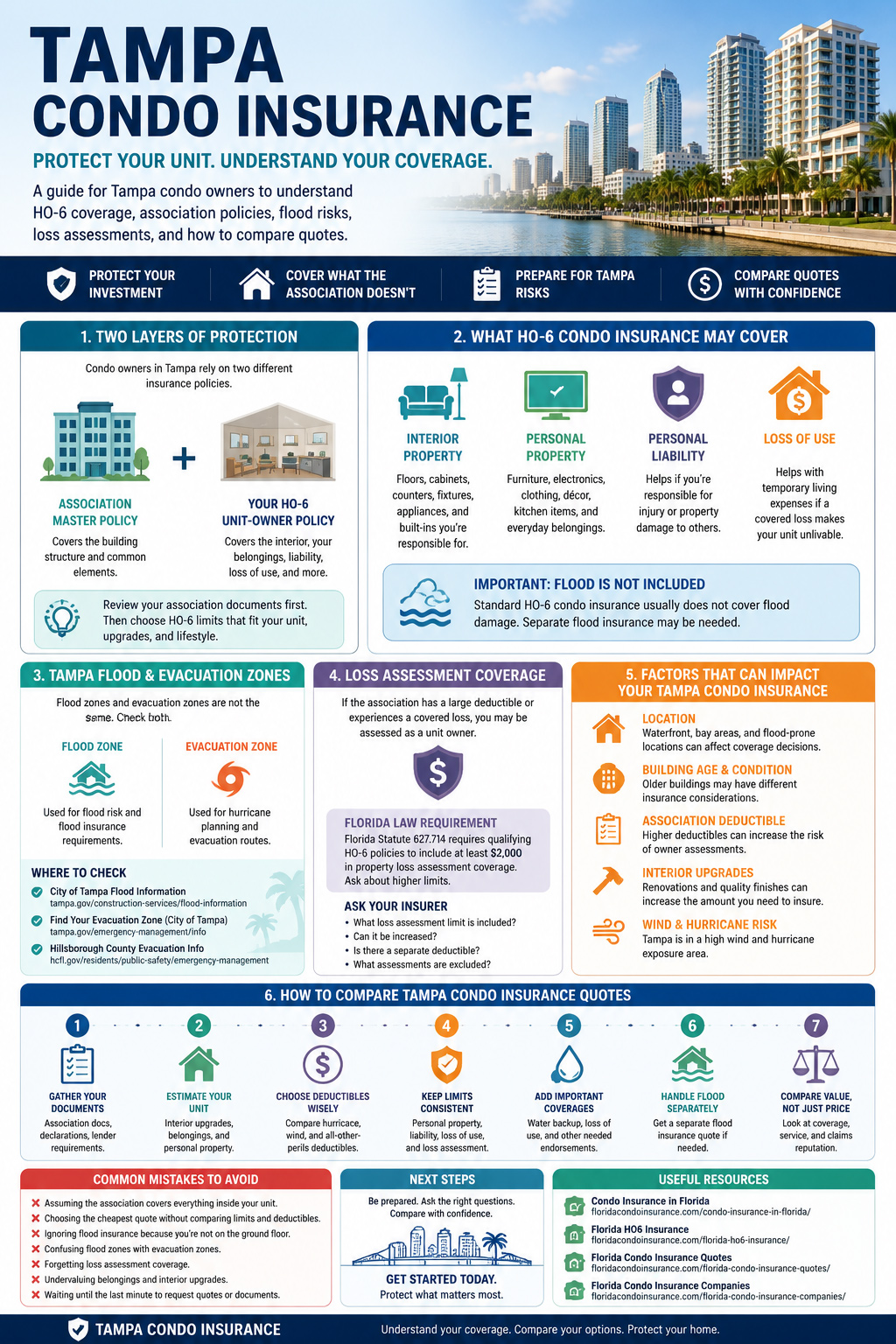
    Infographic explaining Tampa condo insurance, including association master policy, HO-6 coverage, flood and evacuation zones, loss assessment coverage, quote comparison steps, and common mistakes for condo owners.

    Choose the right Tampa condo insurance path

    Tampa condo owners may arrive at this page for different reasons. Some are buying before closing, some are comparing prices, and others are trying to understand whether the association policy leaves gaps inside the unit. Use the table below to choose the best next step without relying on redirected or outdated guide pages.

    If you are… Focus first on… Best next step
    Ready to compare prices Matching limits, deductibles, personal property assumptions, and flood questions. Start with the Florida condo insurance quotes page.
    Buying before closing Lender requirements, association certificate, master policy details, and flood requirements. Use the condo insurance before closing checklist.
    Trying to understand HO-6 Interior building property, personal property, liability, and loss of use. Review the Florida HO6 Insurance guide.
    Focused on low premiums Whether a cheaper quote is using weaker limits, higher deductibles, or missing endorsements. Compare cost with the cheapest condo insurance guide.

    Why Tampa condo insurance needs a local review

    Tampa is not a generic inland condo market. Condo buildings near Downtown Tampa, Harbour Island, Davis Islands, Bayshore Boulevard, Channelside, Westshore, Tampa Palms, New Tampa, South Tampa, and other Hillsborough-area communities can raise different questions about flood exposure, evacuation planning, building age, association reserves, wind deductibles, and interior improvements. The policy type may still be HO-6, but the coverage conversation can change from one building to another.

    The City of Tampa provides flood information and directs residents to local evacuation-zone resources, while Hillsborough County provides evacuation information for hurricane planning. Those tools do not replace insurance advice, but they help condo owners ask better questions before relying on one headline premium. [1] [2]

    Local Tampa factor Why it matters What to review
    Flood-prone location Flood exposure can affect lender requirements and whether separate flood coverage should be discussed. City flood information, FEMA flood mapping, association flood policy, and lender requirements.
    Evacuation zone Evacuation zones are used for hurricane planning and are different from standard insurance-rating questions. City of Tampa and Hillsborough County evacuation-zone resources.
    Waterfront or bay-adjacent building Buildings near Tampa Bay, the Hillsborough River, or low-lying areas may raise stronger flood and evacuation questions. Flood-zone review, association flood coverage, elevation details, and lender requirements.
    Association deductible Shared deductibles or building-level losses may lead to owner assessments in some situations. Master policy, deductible schedule, reserve information, and loss assessment coverage.
    Interior upgrades Renovated flooring, cabinets, countertops, fixtures, and appliances can raise the amount you need to insure. Room-by-room inventory of finishes, upgrades, built-ins, and belongings.

    Association master policy vs. your HO-6 policy

    A Tampa condo owner should not assume that the association’s insurance covers everything inside the unit. Florida Statute 718.111 says a condominium association must use its best efforts to maintain adequate property insurance for association property, common elements, and the condominium property the association must insure. The statute also excludes personal property within the unit and certain interior items such as floor, wall, and ceiling coverings, electrical fixtures, appliances, water heaters, built-in cabinets, countertops, and window treatments located within the unit and serving only that unit. Those items and the insurance on them are the unit owner’s responsibility. [3]

    Coverage layer Usually connected to Tampa owner takeaway
    Association master policy Building property, common elements, and association-level responsibilities. Use it to understand what the building insures before setting your own HO-6 limits.
    HO-6 unit-owner policy Interior property, personal property, liability, loss of use, and owner-level risks. Use it to protect the part of condo ownership that belongs to you, not the association.
    Flood policy Flood damage to building property or contents, depending on the policy. Review separately because standard condo insurance usually does not cover flood damage.

    What HO-6 coverage may protect for Tampa condo owners

    The Florida Office of Insurance Regulation describes HO-6 condo insurance as coverage for condominiums and says it is often called “walls-in” coverage because it covers the interior of the structure while the condo association’s master policy covers the exterior structure and common areas. FLOIR also says HO-6 policies generally provide coverage for building property, personal property, personal liability, and loss of use, and that HO-6 usually does not cover flooding. [4]

    Interior building property

    This can involve the interior features you are responsible for, such as flooring, cabinets, counters, fixtures, appliances, built-ins, and improvements.

    Personal property

    Furniture, electronics, clothing, décor, kitchen items, and everyday belongings should be estimated realistically before you choose a contents limit.

    Personal liability

    Liability coverage may help if you are responsible for injury or property damage involving someone else.

    Loss of use

    Loss of use can help with additional living expenses if a covered loss makes your condo temporarily unlivable.

    Loss assessment coverage deserves special attention

    Loss assessment coverage is important for condo owners because a condominium association may assess unit owners after certain shared losses or association-level deductibles. Florida Statute 627.714 states that unit owner residential property policies issued or renewed on or after July 1, 2010 must include at least $2,000 in property loss assessment coverage for qualifying assessments made as a result of the same direct loss to property, when the loss is of the type covered by the unit owner’s residential property insurance policy. [5]

    Loss assessment questions to ask
    • What loss assessment limit is included in the quote?
    • Can the limit be increased beyond the minimum?
    • Is there a separate deductible for loss assessment coverage?
    • Does it apply to association deductibles after a covered property loss?
    • Which assessments are excluded from the policy?

    Flood insurance and evacuation zones in Tampa

    Flood insurance should be reviewed separately from a standard condo policy. FLOIR states that HO-6 usually does not cover flooding, and additional coverage is needed if flood insurance is desired. For Tampa condo owners, that means a standard quote can look complete while still leaving flood exposure unresolved. [4]

    FloodSmart explains that homeowners in participating NFIP communities, including people who own condominiums and townhouses, can buy flood insurance. It also explains that building and contents coverage are usually purchased separately and may have separate deductibles, which is why Tampa owners should ask about both association building flood coverage and unit-level contents coverage. [6]

    Tampa and Hillsborough evacuation-zone resources should also be reviewed for hurricane planning. Evacuation-zone information is not the same thing as a standard condo policy review, but it can help an owner understand the local context before asking about flood coverage, wind deductibles, loss of use, and temporary living expenses. [1] [2]

    Tampa flood and evacuation checklist
    • Check whether the address is in a flood-prone area.
    • Check the evacuation zone separately from the FEMA flood zone.
    • Ask whether the association carries flood coverage for the building.
    • Ask whether you need contents flood coverage for belongings inside the unit.
    • Review whether your lender requires flood insurance.
    • Compare loss of use coverage in case a covered event makes the unit temporarily unlivable.

    Tampa condo insurance by area and building type

    A Tampa condo insurance quote should reflect the actual building, not only the city name. A high-rise near Channelside, a unit on Harbour Island, a waterfront condo near Bayshore, a Davis Islands property, an older building in South Tampa, or a newer unit in Westshore or New Tampa can each raise different questions about flood, wind, building age, association deductibles, and interior improvements. This is where the Tampa page should be different from a general Florida condo insurance guide.

    Example situation Coverage question to ask
    Downtown Tampa or Channelside condo Does the quote account for building type, association deductibles, and flood discussion?
    Harbour Island or Davis Islands unit Have flood exposure, evacuation planning, and separate flood coverage been reviewed carefully?
    Older South Tampa building Do building age, plumbing, electrical, roof, and association documents affect available quotes?
    Recently renovated unit Are upgraded floors, fixtures, cabinets, countertops, and appliances reflected in the coverage limit?
    Building with large association deductible Is loss assessment coverage strong enough for the building’s deductible and shared-loss risk?

    Tampa condo insurance before closing

    If you are buying a Tampa condo, start the insurance review before the closing package is final. The lender or title company may need proof of coverage, the association certificate of insurance, mortgagee wording, deductible details, and sometimes flood information. Waiting until the last week can lead to rushed quote decisions or missing documents.

    Before closing, confirm these items
    • The association certificate of insurance and master policy summary.
    • The condo declaration or insurance section that explains owner responsibility.
    • The lender’s required limits, deductible rules, and mortgagee clause wording.
    • Whether flood insurance is required or should be quoted separately.
    • Whether loss assessment coverage should be increased beyond the minimum.
    Review Condo Insurance Before Closing

    How to compare Tampa condo insurance quotes

    The cleanest way to compare quotes is to keep the major assumptions consistent. A cheaper quote may simply have a higher deductible, lower personal property limit, lower liability limit, weaker loss assessment coverage, or no separate flood discussion. Once the limits, deductibles, and coverage assumptions are aligned, the premium comparison becomes more meaningful.

    Use this quote comparison method
    1. Start with the association documents before choosing your HO-6 limits.
    2. Estimate personal property and interior upgrades separately.
    3. Compare hurricane, wind, and all-other-perils deductibles carefully.
    4. Keep personal property and liability limits consistent across quotes.
    5. Ask about loss assessment coverage and available higher limits.
    6. Review water backup, loss of use, and other endorsements before comparing price.
    7. Handle flood insurance as a separate quote question.

    Documents to gather before you request a quote

    A Tampa condo insurance quote is only as accurate as the information behind it. If you do not know what the association covers, what your lender requires, or how much your interior upgrades and belongings are worth, the quote may rely on assumptions that do not match your unit.

    Building documents

    • Association insurance certificate
    • Master policy summary if available
    • Condo declaration and bylaws
    • Deductible information
    • Reserve or assessment information if available

    Unit information

    • List of interior upgrades
    • Personal property estimate
    • Current declarations page if insured
    • Preferred deductible range
    • Lender insurance requirements

    Local risk checks

    • Flood-prone area review
    • Evacuation zone check
    • Association flood policy question
    • Separate contents flood discussion
    • Temporary living expense needs

    Common mistakes Tampa condo owners should avoid

    • Assuming the association’s master policy covers everything inside the unit.
    • Choosing the cheapest quote without comparing deductibles and limits.
    • Ignoring flood insurance because the condo is not on the ground floor.
    • Confusing FEMA flood zones and evacuation zones.
    • Forgetting to review loss assessment coverage.
    • Undervaluing furniture, electronics, clothing, and interior upgrades.
    • Not checking whether belongings are covered at replacement cost or actual cash value.
    • Waiting until renewal week or closing week to request association documents.

    Where Tampa condo owners should go next

    For the statewide coverage framework, review our Condo Insurance in Florida guide. For a deeper explanation of the policy type, use our Florida HO6 Insurance page. If you are ready to compare pricing, deductibles, and limits, continue with our Florida Condo Insurance Quotes guide.

    If you are buying a unit, use the Condo Insurance Before Closing in Florida checklist. If you want to compare price and value, review Best & Affordable Condo Insurance in Florida and Cheapest Condo Insurance in Florida. For lender or association questions, see Florida Condo Insurance Requirements.

    Ready to compare?

    Compare Tampa condo insurance quotes with clearer coverage assumptions.

    Review your association policy, estimate your unit-level needs, check flood questions separately, and compare quotes with the same limits and deductibles before choosing coverage.

    FAQ: Tampa condo insurance

    Is condo insurance required in Tampa?

    Many condo owners need HO-6 coverage because of lender requirements, association documents, or practical financial protection. Even when a specific owner is not required in the same way as another owner, coverage can still be important for interior property, belongings, liability, loss of use, and loss assessment exposure.

    Does the association policy cover my Tampa condo unit?

    The association policy may cover building-level property and common elements, but it usually does not cover your personal belongings, liability, temporary living expenses, or many interior items that serve only your unit. Review the association documents before setting your HO-6 limits.

    Does Tampa condo insurance cover flood damage?

    Standard HO-6 condo insurance usually does not cover flood damage. Tampa condo owners should review flood insurance separately, ask what the association carries for the building, and consider whether they need contents flood coverage.

    Are flood zones and evacuation zones the same thing?

    No. Flood-zone information is mainly tied to flood risk and insurance questions, while evacuation-zone information is used for emergency planning. Tampa condo owners should check both because they answer different questions.

    What is loss assessment coverage?

    Loss assessment coverage can help when a condo association assesses owners after certain covered property losses. Florida requires qualifying unit owner residential property policies to include at least $2,000 of property loss assessment coverage, but some owners may want to ask about higher limits.

    How should I compare Tampa condo insurance quotes?

    Compare quotes with the same deductible strategy, similar personal property limits, similar liability limits, the same replacement cost or actual cash value assumption, and a separate flood discussion. A lower premium is not useful if the coverage assumptions are weaker.

    Bottom line

    Tampa condo insurance should be built around your actual building, your association’s insurance setup, your unit-level responsibilities, your belongings, your deductible comfort, and your local flood and evacuation context. The best quote is not simply the lowest premium. It is the policy that fits your real exposure and explains what is included, what is excluded, and what needs to be reviewed separately.

    Before choosing coverage, gather your association documents, estimate your interior upgrades and belongings, ask about loss assessment, and treat flood insurance as its own decision. That gives you a stronger basis for comparing Tampa condo insurance quotes on value rather than price alone.

    Start your Tampa quote review

    Compare Tampa condo insurance quotes using your ZIP code, association documents, flood questions, personal property estimate, and deductible preferences.

    Start Comparing Condo Quotes

    References

    1. City of Tampa, “Flood Information” and “Find Your Evacuation Zone.” Source 1 · Source 2 ·
    2. Hillsborough County, “Find Evacuation Information.” Source ·
    3. Florida Statutes, Section 718.111, “The association — Insurance.” Source ·
    4. Florida Office of Insurance Regulation, “Homeowners Insurance — HO-6 Condo Form.” Source ·
    5. Florida Statutes, Section 627.714, “Residential condominium unit owner coverage; loss assessment coverage required.” Source ·
    6. FEMA FloodSmart, “What you need to know about buying flood insurance.” Source ·
  • Jacksonville Condo Insurance

    Editorial Review
    FCI
    Florida Condo Insurance Editorial Team
    Created: August 14, 2024  |  Updated: June 5, 2026
    About this review
    This page was materially updated for Jacksonville and Duval County condo owners. The article now gives more weight to local Jacksonville risk questions, including the St. Johns River, Downtown and Southbank condos, Jacksonville Beach and Atlantic Beach exposure, Intracoastal Waterway properties, older buildings, flood-zone review, evacuation-zone planning, association deductibles, HO-6 coverage, loss assessment, and quote comparison steps.

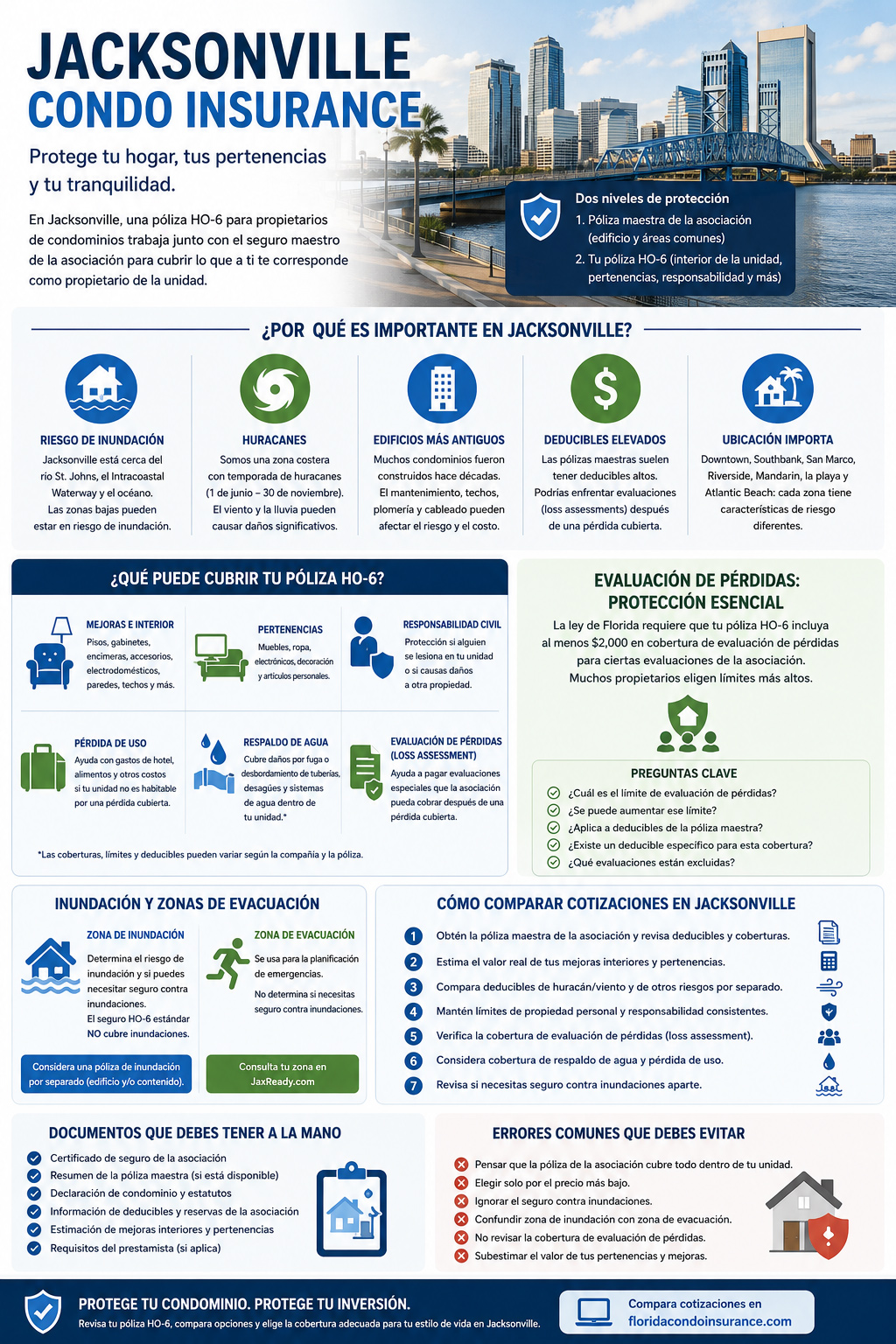
    Jacksonville condo insurance should be reviewed as a local coverage decision, not just a quick price comparison. A condo near the St. Johns River, Southbank, Downtown Jacksonville, San Marco, Riverside, Avondale, Jacksonville Beach, Atlantic Beach, Mandarin, Arlington, or the Intracoastal Waterway can raise different questions about flood exposure, wind deductibles, association insurance, building age, unit upgrades, evacuation planning, and loss assessment risk.

    Most condo owners rely on two insurance layers: the condominium association’s master policy for building-level property and common elements, and the individual unit-owner policy, commonly called an HO-6 policy, for the parts of ownership that belong to the resident. In Jacksonville, the best quote is not automatically the cheapest quote. It is the option that fits your building’s insurance setup, your unit-level responsibilities, your belongings, your deductible comfort, your flood questions, and your loss assessment exposure.

    Quick Jacksonville summary
    • Jacksonville condo insurance should be reviewed by building location, not only by ZIP code.
    • Riverfront, coastal, Intracoastal, and low-lying areas can raise different insurance questions.
    • Flood zones and evacuation zones are not the same thing; both should be checked for different reasons.
    • HO-6 condo insurance usually focuses on interior property, personal belongings, liability, and loss of use.
    • Loss assessment coverage matters because association deductibles and shared losses can affect individual owners.
    • Flood insurance should be reviewed separately because standard HO-6 coverage usually does not cover flood damage.

    Jacksonville condo insurance: what makes this market different

    Jacksonville is a large and varied condo market. A Downtown or Southbank riverfront condo may raise questions about the St. Johns River, building height, shared parking areas, flood insurance, and association deductibles. A Jacksonville Beach or Atlantic Beach unit may require a closer look at coastal wind, storm surge planning, flood coverage, and evacuation-zone context. An older building in Riverside, Avondale, Arlington, or another established area may require extra attention to plumbing, electrical updates, roof responsibility, reserves, and association documentation.

    JaxReady explains that evacuation zones are created using a tiered approach that considers storm surge, freshwater flooding, and isolation. It also notes that Duval County’s most low-lying areas are along the coast and rivers. That matters for emergency planning, but it does not replace an insurance review. A condo owner should still check association documents, flood-zone information, lender requirements, separate flood insurance, and unit-owner HO-6 coverage before relying on one premium. [1]

    Jacksonville location or building factor Why it matters What to review before choosing coverage
    Downtown or Southbank riverfront condo Riverfront buildings can raise questions about flood exposure, shared building areas, parking levels, and association deductibles. Flood map, association flood policy, master policy, loss assessment limit, and loss of use coverage.
    Jacksonville Beach or Atlantic Beach condo Coastal exposure can affect wind, hurricane, flood, evacuation planning, and deductible questions. Wind deductible, hurricane deductible, flood coverage, evacuation zone, and building-level policy details.
    Intracoastal Waterway area Water-adjacent buildings can have flood, drainage, and access questions that are not visible from price alone. Flood-zone review, lender requirements, association flood coverage, contents flood needs, and temporary housing assumptions.
    Riverside, Avondale, San Marco, or older building Older buildings may require closer review of plumbing, electrical, roof, reserves, deductibles, and association responsibility. Building age, inspection notes, master policy summary, reserve information, and water-damage exclusions.
    Recently renovated unit New floors, cabinets, counters, appliances, fixtures, and built-ins can increase the amount the owner may need to insure. Coverage A, upgrade list, receipts if available, replacement cost, and association responsibility language.

    Local checks before buying Jacksonville condo insurance

    Before comparing Jacksonville condo insurance quotes, use local tools and building documents to separate emergency-planning questions from insurance questions. Evacuation-zone tools help with storm planning. Flood maps help frame lender and flood insurance questions. Association documents explain what the building policy may cover and what the unit owner may need to insure separately.

    Local check Why it matters Where to verify
    Evacuation zone Used for emergency planning and evacuation decisions. JaxReady evacuation-zone tools and local emergency guidance.
    Flood map Helps frame flood insurance, lender, and risk questions. FEMA Flood Map Service Center and lender requirements. [2]
    Association master policy Shows what the association insures and where the unit owner may have responsibility. Association certificate of insurance, master policy summary, declaration, and bylaws.
    Association deductible Shared deductibles or building-level losses may lead to assessments in some situations. Deductible schedule, reserves, board documents, and loss assessment coverage.
    Unit interior and belongings Interior upgrades and personal property can change the HO-6 limits you need. Room-by-room inventory, upgrade list, photos, and current declarations page if available.

    Association master policy vs. your HO-6 policy

    A Jacksonville condo owner should not assume that the association’s insurance covers everything inside the unit. Florida Statute 718.111 says a condominium association must use its best efforts to obtain and maintain adequate property insurance for association property, common elements, and condominium property the association is required to insure. The statute also excludes personal property within the unit and certain interior items located within the unit and serving only that unit, including floor, wall, and ceiling coverings, electrical fixtures, appliances, water heaters, built-in cabinets, countertops, and window treatments. [3]

    Coverage layer Usually connected to Jacksonville owner takeaway
    Association master policy Building property, common elements, exterior structure, and association-level responsibilities. Use it to understand what the building insures before setting your own HO-6 limits.
    HO-6 unit-owner policy Interior property, personal property, liability, loss of use, loss assessment, and owner-level risks. Use it to protect the part of condo ownership that belongs to you, not the association.
    Flood policy Flood damage to building property or contents, depending on the policy. Review separately because standard condo insurance usually does not cover flood damage.

    What HO-6 coverage may protect for Jacksonville condo owners

    The Florida Office of Insurance Regulation describes HO-6 condo insurance as coverage for condominiums and says it is often called “walls-in” coverage because it covers the interior of the structure while the condo association’s master policy covers the exterior structure and common areas. FLOIR also says HO-6 policies generally provide coverage for building property, personal property, personal liability, and loss of use, and that HO-6 usually does not cover flooding. [4]

    Interior building property

    This can involve the interior features you are responsible for, such as flooring, cabinets, counters, fixtures, appliances, built-ins, and improvements.

    Personal property

    Furniture, electronics, clothing, décor, kitchen items, and everyday belongings should be estimated realistically before you choose a contents limit.

    Personal liability

    Liability coverage may help if you are responsible for injury or property damage involving someone else.

    Loss of use

    Loss of use can help with additional living expenses if a covered loss makes your condo temporarily unlivable.

    Infographic explaining Jacksonville condo insurance, including HO-6 coverage, association master policy responsibilities, flood zones, evacuation zones, loss assessment coverage, quote comparison steps, and common mistakes for condo owners.

    Before buying a Jacksonville condo policy, check these local issues

    A Jacksonville condo quote can look reasonable and still miss important questions. Before choosing coverage, review whether your property is riverfront, coastal, near the Intracoastal, in an older building, subject to large association deductibles, or dependent on a separate flood policy.

    Riverfront or coastal location

    Ask how the quote handles wind, hurricane deductibles, flood questions, temporary housing, and shared building exposure.

    Evacuation-zone context

    Evacuation zones are for emergency planning. They are useful, but they are not the same as flood insurance requirements.

    Association deductible

    A large building deductible can matter if owners are assessed after a covered association-level loss.

    Unit upgrades

    Renovated flooring, cabinets, countertops, appliances, and fixtures can change the Coverage A limit you may need.

    Loss assessment coverage deserves special attention

    Loss assessment coverage is important because a condominium association may assess unit owners after certain shared losses or association-level deductibles. Florida Statute 627.714 states that residential condominium unit owner policies issued or renewed on or after July 1, 2010 must include at least $2,000 in property loss assessment coverage for qualifying assessments made as a result of the same direct loss to property, when the loss is of the type covered by the unit owner’s residential property insurance policy. [5]

    Loss assessment questions to ask
    • What loss assessment limit is included in the quote?
    • Can the limit be increased beyond the minimum?
    • Is there a separate deductible for loss assessment coverage?
    • Does it apply to association deductibles after a covered property loss?
    • Which assessments are excluded from the policy?
    • How large are the association’s wind, hurricane, and all-other-perils deductibles?

    Flood insurance and evacuation zones in Jacksonville

    Flood insurance should be reviewed separately from a standard condo policy. FloodSmart explains that homeowners in participating NFIP communities, including people who own condominiums and townhouses, can buy flood insurance. FloodSmart also states that building policies can cover up to $250,000 of flood damage and contents policies can cover up to $100,000 for belongings kept inside the home. [6]

    Jacksonville condo owners should treat flood-zone information and evacuation-zone information as separate checks. Flood-zone information helps frame insurance and lender questions, while evacuation-zone information helps with emergency planning. A higher-floor unit can still have shared building, contents, parking, elevator, loss-of-use, or assessment questions after a flood-related event.

    Jacksonville flood and evacuation checklist
    • Check the property’s FEMA flood map context.
    • Check the JaxReady evacuation zone separately.
    • Ask whether the association carries flood coverage for the building.
    • Ask whether you need contents flood coverage for belongings inside the unit.
    • Review whether your lender requires flood insurance.
    • Ask how a flood event could affect common areas, elevators, parking, access, and temporary living needs.

    How to compare Jacksonville condo insurance quotes

    The cleanest way to compare quotes is to keep the major assumptions consistent. A cheaper quote may simply have a higher deductible, lower personal property limit, lower liability limit, weaker loss assessment coverage, actual cash value instead of replacement cost, or no separate flood discussion. Once the limits, deductibles, and coverage assumptions are aligned, the premium comparison becomes more meaningful.

    Use this quote comparison method
    1. Start with the association documents before choosing your HO-6 limits.
    2. Estimate personal property and interior upgrades separately.
    3. Compare hurricane, wind, and all-other-perils deductibles carefully.
    4. Keep personal property and liability limits consistent across quotes.
    5. Ask about loss assessment coverage and available higher limits.
    6. Review water backup, loss of use, replacement cost, and other endorsements before comparing price.
    7. Handle flood insurance as a separate quote question.

    Documents to gather before you request a quote

    A Jacksonville condo insurance quote is only as accurate as the information behind it. If you do not know what the association covers, what your lender requires, or how much your interior upgrades and belongings are worth, the quote may rely on assumptions that do not match your unit.

    Building documents

    • Association insurance certificate
    • Master policy summary if available
    • Condo declaration and bylaws
    • Deductible information
    • Reserve or assessment information if available
    • Association flood policy details if available

    Unit information

    • List of interior upgrades
    • Personal property estimate
    • Current declarations page if insured
    • Preferred deductible range
    • Lender insurance requirements
    • Replacement cost or actual cash value preference

    Local risk checks

    • FEMA flood map review
    • JaxReady evacuation-zone check
    • Association flood policy question
    • Separate contents flood discussion
    • Temporary living expense needs
    • Riverfront, beach, or Intracoastal exposure questions

    Common mistakes Jacksonville condo owners should avoid

    • Assuming the association’s master policy covers everything inside the unit.
    • Choosing the cheapest quote without comparing deductibles and limits.
    • Ignoring flood insurance because the condo is not directly on the beach.
    • Confusing flood zones and evacuation zones.
    • Forgetting to review loss assessment coverage.
    • Undervaluing furniture, electronics, clothing, and interior upgrades.
    • Not asking whether belongings are covered at replacement cost or actual cash value.
    • Ignoring shared areas such as elevators, parking, storage rooms, and access points.
    • Waiting until renewal week or closing week to request association documents.

    Useful next steps for Florida condo owners

    For a broader statewide explanation, review our Condo Insurance in Florida guide. For a deeper explanation of the policy type, use our Florida HO6 Insurance page. If you are ready to compare options, continue with our Florida Condo Insurance Quotes guide.

    You can also compare broader insurer options through our Florida Condo Insurance Companies page, review pricing-focused guidance in our Cheapest Condo Insurance in Florida guide, or browse other local pages from our Florida condo insurance city guide.

    Ready to compare?
    Compare Jacksonville condo insurance with clearer coverage assumptions.

    Review your association policy, estimate your unit-level needs, and compare quotes with the same limits and deductibles before choosing coverage.

    FAQ: Jacksonville condo insurance

    Is condo insurance required in Jacksonville?

    Many condo owners need HO-6 coverage because of lender requirements, association documents, or practical financial protection. Even when a specific owner is not required in the same way as another owner, coverage can still be important for interior property, belongings, liability, loss of use, and loss assessment exposure.

    Does the association policy cover my Jacksonville condo unit?

    The association policy may cover building-level property and common elements, but it usually does not cover your personal belongings, liability, temporary living expenses, or many interior items that serve only your unit. Review the association documents before setting your HO-6 limits.

    Does Jacksonville condo insurance cover flood damage?

    Standard HO-6 condo insurance usually does not cover flood damage. Jacksonville condo owners should review flood insurance separately, ask what the association carries for the building, and consider whether they need contents flood coverage.

    Are flood zones and evacuation zones the same thing?

    No. Flood-zone information is mainly tied to flood risk and insurance questions, while evacuation-zone information is used for emergency planning. Jacksonville condo owners should check both because they answer different questions.

    Do Jacksonville Beach condo owners need separate flood insurance?

    They should at least review it. A standard HO-6 policy usually does not cover flood damage, so beach-area condo owners should ask about the association flood policy, lender requirements, and whether contents flood coverage is needed.

    Does a higher-floor Jacksonville condo still need flood review?

    Yes. Even if the unit itself is above ground level, flood-related damage can affect common areas, elevators, parking, storage, access, association deductibles, and temporary living needs. The unit owner should still review the building’s flood coverage and their own contents needs.

    What should Southbank or Downtown Jacksonville condo owners ask before buying HO-6 coverage?

    They should ask how the quote handles interior building property, personal belongings, loss of use, flood questions, association deductibles, loss assessment, parking or storage areas, and any building-specific requirements from the lender or association.

    What is loss assessment coverage?

    Loss assessment coverage can help when a condo association assesses owners after certain covered property losses. Florida requires qualifying unit owner residential property policies to include at least $2,000 of property loss assessment coverage, but some owners may want to ask about higher limits.

    How should I compare Jacksonville condo insurance quotes?

    Compare quotes with the same deductible strategy, similar personal property limits, similar liability limits, the same replacement cost or actual cash value assumption, similar loss assessment limits, and a separate flood discussion. A lower premium is not useful if the coverage assumptions are weaker.

    Bottom line

    Jacksonville condo insurance should be built around your actual building, your association’s insurance setup, your unit-level responsibilities, your belongings, your deductible comfort, and your local flood and evacuation context. The best quote is not simply the lowest premium. It is the policy that fits your real exposure and explains what is included, what is excluded, and what needs to be reviewed separately.

    Before choosing coverage, gather your association documents, estimate your interior upgrades and belongings, ask about loss assessment, and treat flood insurance as its own decision. That gives you a stronger basis for comparing Jacksonville condo insurance quotes on value rather than price alone.

    References

    1. JaxReady, “Evacuation Information” and “Evacuation Zones.” Source 1 · Source 2 ·
    2. FEMA Flood Map Service Center, official flood map search and flood hazard information. Source ·
    3. Florida Statutes, Section 718.111, “The association — Insurance.” Source ·
    4. Florida Office of Insurance Regulation, “Homeowners Insurance — HO-6 Condo Form.” Source ·
    5. Florida Statutes, Section 627.714, “Residential condominium unit owner coverage; loss assessment coverage required.” Source ·
    6. FEMA FloodSmart, “What you need to know about buying flood insurance.” Source ·
  • Orlando Condo Insurance

    Editorial Review
    FCI
    Florida Condo Insurance Editorial Team
    Created: August 13, 2024  |  Updated: June 5, 2026
    About this review
    This Orlando condo insurance guide was revised to add more local value for condo owners in Central Florida, including inland floodplain review, lake-adjacent drainage questions, association deductible exposure, buyer and closing document checklists, HO-6 coverage basics, loss assessment coverage, separate flood insurance reminders, and Orlando neighborhood examples.

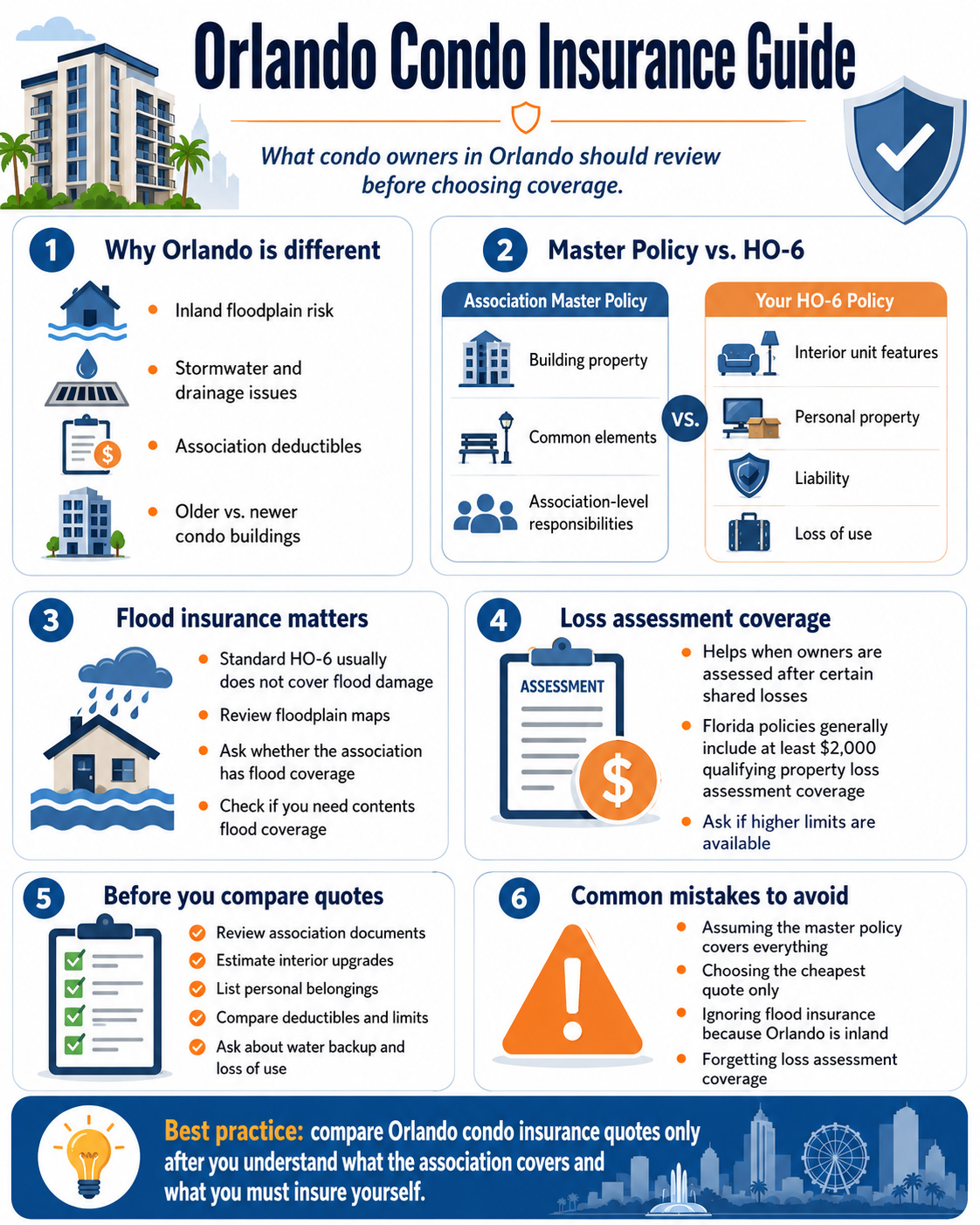
    Orlando condo insurance is different from coastal Florida condo insurance. The main question is often not beachfront storm surge, but whether the unit owner understands inland floodplain exposure, lake-adjacent drainage, association deductibles, older building systems, interior upgrade responsibility, and the limits of a standard HO-6 condo policy.

    A condo owner in Downtown Orlando, Lake Eola, Baldwin Park, Lake Nona, MetroWest, International Drive, College Park, Winter Park, or another Orange County area usually depends on two layers of protection: the condominium association’s master policy for building-level responsibilities and the unit owner’s HO-6 policy for personal property, interior items, liability, loss of use, and owner-level risks. A separate flood insurance discussion may also be needed because standard HO-6 coverage usually does not cover flooding.

    Quick Orlando coverage summary
    • Orlando condo owners should review both the association master policy and their own HO-6 unit-owner policy before comparing quotes.
    • Inland floodplain exposure matters in Orlando because heavy rain, lakes, drainage issues, and mapped flood zones can affect coverage questions.
    • HO-6 coverage usually focuses on the owner’s interior responsibility, personal belongings, liability, loss of use, and loss assessment exposure.
    • Association deductibles can matter because some shared losses may result in assessments to individual unit owners.
    • The best Orlando condo insurance quote is the one that matches the building, lender requirements, deductible comfort, interior upgrades, and flood coverage needs.

    Why Orlando condo insurance needs a different review than coastal Florida

    Orlando is inland, but inland does not mean risk-free. Condo buildings can still be affected by tropical rain, drainage problems, aging roofs, older plumbing, electrical systems, association maintenance decisions, and lake-adjacent or low-lying areas. That is why a quote based only on ZIP code and price can miss important coverage questions.

    The City of Orlando provides floodplain and flooding information, including local floodplain resources and FEMA flood-zone map guidance. Orange County also provides hurricane preparation guidance for severe weather. These tools do not replace insurance advice, but they help Orlando condo owners ask better questions before choosing a policy. [1] [2]

    Orlando condo situation Why it can affect insurance What the owner should check
    Downtown Orlando or Lake Eola condo High-rise buildings, lake proximity, shared systems, and association deductibles can make coverage assumptions more important. Master policy certificate, wind deductible, loss assessment limit, floodplain map, and interior improvement coverage.
    Baldwin Park or lake-adjacent unit Lakes, stormwater systems, and drainage patterns can raise questions that a standard HO-6 quote may not fully address. Floodplain resources, association flood policy, water backup option, and contents flood coverage.
    Lake Nona or newer development Newer buildings may still have lender requirements, association deductibles, and upgraded interiors that need proper limits. Lender HO-6 requirements, unit upgrades, replacement cost option, and association insurance documents.
    MetroWest or older condo community Older buildings may bring more questions about plumbing, roof age, electrical systems, maintenance, and reserves. Building age, maintenance history, deductible schedule, association reserves, and available endorsements.
    International Drive or rental-adjacent area Some owners may use units seasonally, as second homes, or near rental-heavy areas, which can affect eligibility and coverage needs. Occupancy status, association rental rules, insurer eligibility, liability limit, and loss of use details.
    Winter Park or higher-value interior finishes Renovated flooring, cabinets, countertops, appliances, fixtures, and built-ins may require stronger interior property limits. Replacement cost estimate, improvements and betterments, personal property inventory, and deductible choices.

    Association master policy vs. your Orlando HO-6 policy

    An Orlando condo owner should not assume the association’s master policy covers everything inside the unit. Florida Statute 718.111 requires condominium associations to use their best efforts to obtain and maintain adequate property insurance for association property, common elements, and condominium property the association must insure. The statute also excludes personal property within the unit and certain interior items that serve only that unit, including floor, wall, and ceiling coverings, electrical fixtures, appliances, water heaters, built-in cabinets, countertops, and window treatments. [3]

    Coverage layer Usually connected to Orlando owner takeaway
    Association master policy Building property, common elements, association-level responsibilities, and shared building risks. Use it to understand what the building insures before setting your own HO-6 limits.
    HO-6 unit-owner policy Interior property, personal belongings, personal liability, loss of use, and owner-level risks. Use it to protect the part of condo ownership that belongs to you, not the association.
    Flood policy Flood damage to building property or contents, depending on the policy and who owns the insured property. Review separately because standard condo insurance usually does not cover flood damage.

    What an Orlando HO-6 condo policy may cover

    The Florida Office of Insurance Regulation describes HO-6 condo insurance as coverage for condominiums and notes that it is often called “walls-in” coverage because it generally covers the interior of the structure while the condo association’s master policy covers the exterior structure and common areas. FLOIR also says HO-6 policies generally provide coverage for building property, personal property, personal liability, and loss of use, while HO-6 usually does not cover flooding. [4]

    Interior building property

    This can include flooring, cabinets, countertops, fixtures, appliances, built-ins, and other interior features you are responsible for under the association documents.

    Personal property

    Furniture, electronics, clothing, décor, kitchen items, and everyday belongings should be estimated realistically before choosing a contents limit.

    Personal liability

    Liability coverage may help if you are responsible for injury or property damage involving someone else.

    Loss of use

    Loss of use can help with additional living expenses if a covered loss makes your condo temporarily unlivable.

    Orlando condo insurance before closing: documents to gather

    Many condo insurance mistakes happen before a policy is even purchased. A buyer may request a fast quote without knowing the association deductible, the master policy structure, the lender’s HO-6 requirements, or whether flood insurance is required. Before closing on an Orlando condo, gather the documents that show what the association covers and what the unit owner still needs to insure.

    Association documents

    • Association insurance certificate
    • Master policy declarations or summary
    • Wind or hurricane deductible information
    • Flood policy confirmation if available
    • Condo declaration, bylaws, and insurance responsibility language

    Unit information

    • List of interior upgrades
    • Personal property estimate
    • Current declarations page if already insured
    • Preferred deductible range
    • Replacement cost or actual cash value preference

    Local risk checks

    • City of Orlando floodplain review
    • FEMA flood-zone map check
    • Association flood coverage question
    • Contents flood insurance question
    • Temporary living expense needs after a covered loss

    Loss assessment coverage deserves special attention in Orlando

    Loss assessment coverage matters because a condominium association may assess unit owners after certain shared losses or association-level deductibles. Florida Statute 627.714 states that unit owner residential property policies issued or renewed on or after July 1, 2010 must include at least $2,000 in property loss assessment coverage for qualifying assessments made as a result of the same direct loss to property, when the loss is of the type covered by the unit owner’s residential property insurance policy. [5]

    Loss assessment questions to ask before choosing a quote
    • What loss assessment limit is included in the quote?
    • Can the limit be increased beyond the minimum?
    • Is there a separate deductible for loss assessment coverage?
    • Does it apply to association deductibles after a covered property loss?
    • Which assessments are excluded from the policy?
    • Does the association have a large hurricane, wind, or property deductible that could affect owners?

    Flood insurance and inland floodplain risk in Orlando

    Flood insurance should be reviewed separately from a standard condo policy. FLOIR states that HO-6 usually does not cover flooding and that additional coverage is needed if flood insurance is desired. For Orlando condo owners, that means a standard quote can look complete while still leaving flood exposure unresolved. [4]

    Orlando’s floodplain resources are useful because inland flooding is not the same conversation as beachfront storm surge, but it can still affect property risk. Condo owners should ask whether the association carries flood coverage for the building, whether contents flood coverage is needed for belongings, whether the lender requires separate flood insurance, and whether the unit is in or near a mapped floodplain. [1]

    Orlando flood and storm checklist
    • Check whether the address is in or near a mapped floodplain.
    • Review FEMA flood-zone map resources for the property area.
    • Ask whether the association carries flood coverage for the building.
    • Ask whether you need contents flood coverage for belongings inside the unit.
    • Review whether your lender requires flood insurance.
    • Compare loss of use coverage in case a covered event makes the unit temporarily unlivable.
    • Ask about water backup coverage separately from flood coverage.

    Infographic explaining Orlando condo insurance, including inland floodplain risk, association master policy, HO-6 coverage, loss assessment coverage, flood insurance, quote comparison steps, and common mistakes for condo owners.

    How to compare Orlando condo insurance quotes

    The cleanest way to compare Orlando condo insurance quotes is to keep the major assumptions consistent. A lower premium may simply reflect a higher deductible, lower personal property limit, lower liability limit, weaker loss assessment coverage, no replacement cost option, or no separate flood discussion. Once the limits, deductibles, and coverage assumptions are aligned, the premium comparison becomes more meaningful.

    Use this quote comparison method
    1. Start with the association documents before choosing your HO-6 limits.
    2. Estimate personal property and interior upgrades separately.
    3. Compare hurricane, wind, and all-other-perils deductibles carefully.
    4. Keep personal property and liability limits consistent across quotes.
    5. Ask about loss assessment coverage and available higher limits.
    6. Review water backup, loss of use, replacement cost, and other endorsements before comparing price.
    7. Handle flood insurance as a separate quote question.
    8. Confirm whether occupancy, seasonal use, or rental use affects eligibility.

    Common mistakes Orlando condo owners should avoid

    • Assuming the association’s master policy covers everything inside the unit.
    • Choosing the cheapest quote without comparing deductibles and limits.
    • Ignoring flood insurance because Orlando is inland.
    • Forgetting to review loss assessment coverage.
    • Undervaluing furniture, electronics, clothing, and interior upgrades.
    • Not asking whether belongings are covered at replacement cost or actual cash value.
    • Waiting until renewal week or closing week to request association documents.
    • Comparing quotes that use different deductibles, limits, or coverage assumptions.
    • Not checking whether seasonal use, vacancy, or rental use changes the quote.

    Useful next steps for Florida condo owners

    For a broader statewide explanation, review our Condo Insurance in Florida guide. For a deeper explanation of the policy type, use our Florida HO6 Insurance page. If you are comparing policies, continue with our Florida Condo Insurance Quotes guide.

    You can also compare broader options through our Florida Condo Insurance Companies guide, review statewide rules in our Florida Condo Insurance Requirements page, or browse other local pages from our Florida condo insurance city guide.

    Ready to compare?

    Compare Orlando condo insurance with clearer coverage assumptions.

    Review your association policy, estimate your unit-level needs, and compare quotes with the same limits and deductibles before choosing coverage.

    FAQ: Orlando condo insurance

    Is condo insurance required in Orlando?

    Many Orlando condo owners need HO-6 coverage because of lender requirements, association documents, or practical financial protection. Even when a specific owner is not required in the same way as another owner, coverage can still be important for interior property, belongings, liability, loss of use, and loss assessment exposure.

    Does the association policy cover my Orlando condo unit?

    The association policy may cover building-level property and common elements, but it usually does not cover your personal belongings, liability, temporary living expenses, or many interior items that serve only your unit. Review the association documents before setting your HO-6 limits.

    Does Orlando condo insurance cover flood damage?

    Standard HO-6 condo insurance usually does not cover flood damage. Orlando condo owners should review flood insurance separately, ask what the association carries for the building, and consider whether they need contents flood coverage.

    Why does flood insurance matter if Orlando is inland?

    Inland areas can still face flooding from heavy rain, drainage problems, lakes, low-lying land, and mapped floodplains. A condo owner should review local floodplain information and ask whether standard HO-6 coverage leaves flood exposure outside the policy.

    What should I check before buying a condo near Lake Eola, Baldwin Park, or Lake Nona?

    Ask for the association insurance certificate, master policy summary, deductible schedule, flood policy information, and rules about what the owner must insure. Also review the unit’s interior upgrades and whether the address is in or near a mapped floodplain.

    Can an Orlando condo association deductible affect my HO-6 policy?

    It can. If the association has a large deductible or a shared covered property loss, individual owners may face assessments in some situations. That is why loss assessment coverage should be reviewed before choosing the lowest quote.

    Is Orlando condo insurance different from Miami or Tampa condo insurance?

    The basic HO-6 policy structure may be similar, but the risk conversation can differ. Orlando owners often need to focus on inland floodplain exposure, lake-adjacent drainage, building age, association deductibles, and whether a separate flood policy is needed.

    How should I compare Orlando condo insurance quotes?

    Compare quotes with the same deductible strategy, similar personal property limits, similar liability limits, the same replacement cost or actual cash value assumption, and a separate flood discussion. A lower premium is not useful if the coverage assumptions are weaker.

    Bottom line

    Orlando condo insurance should be built around the actual building, the association’s insurance setup, the owner’s interior responsibilities, the unit’s belongings and upgrades, the deductible structure, and the property’s local floodplain context. The best quote is not simply the lowest premium. It is the policy that explains what is included, what is excluded, and what needs to be reviewed separately.

    Before choosing coverage, gather your association documents, estimate your interior upgrades and belongings, ask about loss assessment, and treat flood insurance as its own decision. That gives you a stronger basis for comparing Orlando condo insurance quotes on value rather than price alone.

    References

    1. City of Orlando, “Floodplain and Flooding Information.”

      Source
      ·

    2. Orange County, “Hurricane Safety Guide.”

      Source
      ·

    3. Florida Statutes, Section 718.111, “The association — Insurance.”

      Source
      ·

    4. Florida Office of Insurance Regulation, “Homeowners Insurance — HO-6 Condo Form.”

      Source
      ·

    5. Florida Statutes, Section 627.714, “Residential condominium unit owner coverage; loss assessment coverage required.”

      Source
      ·

  • Condo Insurance Naples Florida

    Editorial Review
    FCI
    Florida Condo Insurance Editorial Team
    Created: July 8, 2024  |  Updated: June 5, 2026
    About this review
    This page was reviewed again for Naples condo owners on June 5, 2026, with stronger local quote guidance, Collier County floodplain and evacuation context, before-closing insurance steps, Florida HO-6 coverage details, association-versus-unit-owner responsibility, loss assessment guidance, flood insurance reminders, internal links to related guides, and common mistakes to avoid.

    Naples condo insurance should be reviewed as a local coverage decision, not just a statewide quote search. A condo owner usually relies on two different insurance layers: the condominium association’s master policy for the building and common elements, and an individual unit-owner policy, commonly called an HO-6 policy, for the parts of ownership that belong to the resident.

    In Naples and Collier County, that decision can be shaped by Gulf Coast storm exposure, flood-zone information, hurricane surge evacuation zones, older coastal buildings, association deductibles, interior upgrades, lender requirements, and how much risk the unit owner is willing to carry after a covered loss. The best policy is not automatically the cheapest quote. It is the quote that matches your building’s insurance setup, your personal property, your interior responsibility, your deductible comfort, your loss assessment exposure, and your separate flood insurance needs.

    Quick summary
    • Naples condo owners should review both the association master policy and their own HO-6 unit-owner policy.
    • Flood zones, hurricane surge evacuation zones, and storm-surge exposure are related but not the same thing.
    • HO-6 condo insurance usually focuses on interior property, personal belongings, liability, and loss of use.
    • Loss assessment coverage matters because association deductibles and shared losses can affect individual owners.
    • Flood insurance should be reviewed separately because standard HO-6 coverage usually does not cover flood damage.
    Naples condo quotes

    Compare Naples condo insurance options by ZIP code, building type, association documents, flood exposure, hurricane deductible questions, personal property limits, and loss assessment needs.

    Compare Naples Condo Insurance Quotes
    If you are… Use this next Why it helps a Naples condo owner
    Ready to compare pricing Florida Condo Insurance Quotes Compare deductibles, limits, coverage assumptions, and flood questions before choosing the lowest premium.
    Buying before closing Condo Insurance Before Closing Prepare lender, title company, association, flood-zone, and proof-of-insurance questions earlier.
    Checking association rules Florida Condo Insurance Requirements Review how association documents, lenders, and unit-owner responsibilities affect coverage decisions.
    Shopping by value Best Condo Insurance in Florida Look beyond price and compare coverage quality, company fit, and policy details.
    Focused on cost Cheapest Condo Insurance in Florida Compare lower-cost options without ignoring flood, deductibles, loss assessment, or weak limits.
    Infographic explaining Naples condo insurance, including HO-6 coverage, association master policy responsibilities, flood zones, hurricane surge evacuation zones, storm surge exposure, loss assessment coverage, quote comparison steps, and common mistakes for condo owners.

    Why Naples condo insurance needs local context

    Naples is a coastal condo market where location can change the coverage conversation. A unit in Old Naples, Park Shore, Moorings, Pelican Bay, Vanderbilt Beach, East Naples, North Naples, or near Gulf-front and bayfront areas can raise different questions about flood exposure, wind deductibles, building age, association reserves, exterior maintenance, interior improvements, and shared deductibles.

    The City of Naples provides an official flood-zone map tool so property owners can check whether an address lies in a Special Flood Hazard Area. Its hurricane-preparedness guidance also tells residents to look up their hurricane surge evacuation zone and notes that hurricane surge evacuation zones are different from flood zones. Collier County also maintains floodplain-management information tied to finalized 2024 FEMA flood map data and provides evacuation-zone information for address-based planning. Those tools do not replace insurance advice, but they help condo owners ask better questions before relying on one headline premium. [1]

    Naples condo factor Why it matters What to review
    Gulf Coast exposure Coastal properties can raise wind, flood, storm-surge, and evacuation questions. Flood map, evacuation zone, lender requirements, wind deductible, and flood insurance options.
    Association insurance split Different buildings leave different repair and insurance responsibilities to the unit owner. Master policy summary, declaration, bylaws, certificate of insurance, and deductible schedule.
    Older coastal buildings Building age, roof, plumbing, electrical, and maintenance history may affect underwriting and owner exposure. Association documents, recent repairs, reserve information, and insurance certificates.
    Interior upgrades Custom flooring, cabinetry, countertops, fixtures, and built-ins can change the amount you need to insure. Room-by-room estimate of finishes, improvements, appliances, and personal property.
    Association deductibles Large building-level deductibles can affect unit owners through assessments after certain losses. Loss assessment coverage, association deductible schedule, reserves, and assessment history.

    Flood zone, evacuation zone, and storm surge are not the same thing

    Naples condo owners should not treat flood-zone information and evacuation-zone information as interchangeable. A flood zone mainly helps identify areas susceptible to flooding and can affect lender and insurance questions. A hurricane surge evacuation zone is used for emergency planning when local officials issue evacuation guidance. Storm surge is the coastal water rise caused by a storm, and it can affect areas differently from standard rain-driven flooding.

    Local risk tool Main purpose Insurance takeaway
    Flood zone Identifies flood-prone areas and Special Flood Hazard Areas. Ask whether flood insurance is required or strongly worth considering.
    Hurricane surge evacuation zone Helps residents know when they may need to evacuate during storm-surge threats. Useful for emergency planning, but it is not a replacement for insurance review.
    Storm surge exposure Shows how coastal storm water can affect low-lying areas during hurricanes. Raises questions about flood insurance, association flood coverage, and loss of use.

    Association master policy vs. your HO-6 policy

    A Naples condo owner should not assume that the association’s insurance covers everything inside the unit. Florida Statute 718.111 says a condominium association must use its best efforts to obtain and maintain adequate property insurance for association property, common elements, and condominium property the association must insure. The statute also excludes personal property within the unit and certain interior items located within the unit and serving only that unit, including floor, wall, and ceiling coverings, electrical fixtures, appliances, water heaters, built-in cabinets, countertops, and window treatments. Those items and the insurance on them are the unit owner’s responsibility. [2]

    Coverage layer Usually connected to Naples owner takeaway
    Association master policy Building property, common elements, exterior structure, and association-level responsibilities. Use it to understand what the building insures before setting your own HO-6 limits.
    HO-6 unit-owner policy Interior property, personal property, liability, loss of use, and owner-level risks. Use it to protect the part of condo ownership that belongs to you, not the association.
    Flood policy Flood damage to building property or contents, depending on the policy. Review separately because standard condo insurance usually does not cover flood damage.

    What HO-6 coverage may protect for Naples condo owners

    The Florida Office of Insurance Regulation describes HO-6 condo insurance as coverage for condominiums and says it is often called “walls-in” coverage because it covers the interior of the structure while the condo association’s master policy covers the exterior structure and common areas. FLOIR also says HO-6 policies generally provide coverage for building property, personal property, personal liability, and loss of use, and that HO-6 usually does not cover flooding. [3]

    Interior building property

    This can involve the interior features you are responsible for, such as flooring, cabinets, counters, fixtures, appliances, built-ins, and improvements.

    Personal property

    Furniture, electronics, clothing, décor, kitchen items, and everyday belongings should be estimated realistically before you choose a contents limit.

    Personal liability

    Liability coverage may help if you are responsible for injury or property damage involving someone else.

    Loss of use

    Loss of use can help with additional living expenses if a covered loss makes your condo temporarily unlivable.

    Loss assessment coverage deserves special attention

    Loss assessment coverage is important because a condominium association may assess unit owners after certain shared losses or association-level deductibles. Florida Statute 627.714 states that residential condominium unit owner policies issued or renewed on or after July 1, 2010 must include at least $2,000 in property loss assessment coverage for qualifying assessments made as a result of the same direct loss to property, when the loss is of the type covered by the unit owner’s residential property insurance policy. [4]

    Loss assessment questions to ask
    • What loss assessment limit is included in the quote?
    • Can the limit be increased beyond the minimum?
    • Is there a separate deductible for loss assessment coverage?
    • Does it apply to association deductibles after a covered property loss?
    • Which assessments are excluded from the policy?

    Flood insurance for Naples condo owners

    Flood insurance should be reviewed separately from a standard condo policy. FLOIR states that HO-6 usually does not cover flooding. FloodSmart also explains that homeowners in participating NFIP communities, including people who own condominiums and townhouses, can buy flood insurance, and that contents policies can cover belongings kept inside the home. FEMA NFIP condominium materials also explain that a Residential Condominium Building Association Policy, or RCBAP, is available to associations to insure against direct physical flood damage to the building. [5]

    Naples flood insurance questions
    • Does the association carry flood coverage for the building?
    • Does the association’s flood policy cover only building property?
    • Do you need contents flood coverage for belongings inside your unit?
    • Does your lender require flood insurance?
    • Are NFIP and private flood options available for your situation?
    • Does your quote clearly separate flood, water backup, and wind-related damage?

    Naples condo insurance before closing

    Naples condo buyers should not wait until closing week to review insurance. A lender, title company, or condo association may ask for proof of coverage, mortgagee information, association insurance details, flood-zone documentation, or confirmation that the unit-owner policy lines up with the building’s master policy. Coastal and high-value condo purchases can move more smoothly when the buyer requests these documents early.

    Before closing, request Why it matters in Naples
    Association certificate of insurance Shows the building-level insurance picture before you decide how much HO-6 coverage to quote.
    Master policy and deductible details Helps identify shared deductible, wind, hurricane, and loss assessment questions.
    Flood-zone and lender instructions Helps prevent a last-minute flood insurance or proof-of-coverage issue before closing.
    Interior upgrades and personal property estimate Helps avoid a quote that undervalues renovated finishes, furnishings, or belongings.
    Closing checklist

    Buying soon? Use the Condo Insurance Before Closing in Florida guide before finalizing a Naples condo quote, especially if your lender needs proof of HO-6 coverage or flood-related documentation.

    Naples building and neighborhood examples

    A Naples condo insurance quote should reflect the actual building, not only the city name. A Gulf-front unit, an Old Naples condo, a Park Shore high-rise, a Moorings building, a Pelican Bay property, a Vanderbilt Beach unit, an East Naples condo, or a North Naples unit can each raise different questions about flood, wind, building age, association deductibles, interior improvements, and shared losses.

    Example situation Coverage question to ask
    Gulf-front or bayfront condo Have flood, storm surge, wind deductible, and evacuation-zone questions been reviewed separately?
    Old Naples or Park Shore unit Do building age, association reserves, and master-policy deductibles affect the quote?
    Pelican Bay or Vanderbilt Beach property Are interior upgrades, association flood coverage, and loss assessment limits strong enough?
    East Naples or North Naples condo Has the owner checked flood maps and association documents instead of assuming lower risk?
    Recently renovated unit Are upgraded floors, fixtures, cabinets, countertops, and appliances reflected in the coverage limit?

    How to compare Naples condo insurance quotes

    The cleanest way to compare Naples condo insurance quotes is to keep the major assumptions consistent. A cheaper quote may simply have a higher deductible, lower personal property limit, lower liability limit, weaker loss assessment coverage, or no separate flood discussion. Once the limits, deductibles, and coverage assumptions are aligned, the premium comparison becomes more meaningful.

    Use this quote comparison method
    1. Start with the association documents before choosing your HO-6 limits.
    2. Estimate personal property and interior upgrades separately.
    3. Compare hurricane, wind, and all-other-perils deductibles carefully.
    4. Keep personal property and liability limits consistent across quotes.
    5. Ask about loss assessment coverage and available higher limits.
    6. Review water backup, loss of use, special limits, and other endorsements before comparing price.
    7. Handle flood insurance as a separate quote question.

    Documents to gather before you request a quote

    A Naples condo insurance quote is only as accurate as the information behind it. If you do not know what the association covers, what your lender requires, or how much your interior upgrades and belongings are worth, the quote may rely on assumptions that do not match your unit.

    Building documents

    • Association insurance certificate
    • Master policy summary if available
    • Condo declaration and bylaws
    • Deductible information
    • Reserve or assessment information if available

    Unit information

    • List of interior upgrades
    • Personal property estimate
    • Current declarations page if insured
    • Preferred deductible range
    • Lender insurance requirements

    Local risk checks

    • Flood-zone review
    • Hurricane surge evacuation-zone check
    • Association flood policy question
    • Separate contents flood discussion
    • Temporary living expense needs

    Common mistakes Naples condo owners should avoid

    • Assuming the association’s master policy covers everything inside the unit.
    • Choosing the cheapest quote without comparing deductibles and limits.
    • Ignoring flood insurance because the unit is on an upper floor.
    • Confusing flood zones, hurricane surge evacuation zones, and storm-surge exposure.
    • Forgetting to review loss assessment coverage.
    • Undervaluing furniture, electronics, clothing, and interior upgrades.
    • Not asking whether belongings are covered at replacement cost or actual cash value.
    • Waiting until renewal week or closing week to request association documents.

    Where Naples condo owners should go next

    For the statewide framework, review our Condo Insurance in Florida guide. For a deeper explanation of the policy type, use our Florida HO-6 Insurance page. If you need proof of coverage before a purchase, continue with Condo Insurance Before Closing in Florida. If you are ready to compare pricing and policy details, use our Florida Condo Insurance Quotes guide.

    Naples owners who are comparing the market should also review Florida Condo Insurance Requirements, Best Condo Insurance in Florida, Cheapest Condo Insurance in Florida, and Florida Condo Insurance Companies before deciding based only on premium.

    Ready to compare?

    Compare Naples condo insurance with clearer coverage assumptions.

    Review your association policy, estimate your unit-level needs, and compare quotes with the same limits and deductibles before choosing coverage.

    FAQ: Naples condo insurance

    Is condo insurance required in Naples?

    Many condo owners need HO-6 coverage because of lender requirements, association documents, or practical financial protection. Even when a specific owner is not required in the same way as another owner, coverage can still be important for interior property, belongings, liability, loss of use, and loss assessment exposure.

    Does the association policy cover my Naples condo unit?

    The association policy may cover building-level property and common elements, but it usually does not cover your personal belongings, liability, temporary living expenses, or many interior items that serve only your unit. Review the association documents before setting your HO-6 limits.

    Does Naples condo insurance cover flood damage?

    Standard HO-6 condo insurance usually does not cover flood damage. Naples condo owners should review flood insurance separately, ask what the association carries for the building, and consider whether they need contents flood coverage.

    Are flood zones and hurricane surge evacuation zones the same thing?

    No. Flood-zone information is mainly tied to flood risk and insurance questions, while hurricane surge evacuation zones are used for emergency planning. Naples condo owners should check both because they answer different questions.

    What is loss assessment coverage?

    Loss assessment coverage can help when a condo association assesses owners after certain covered property losses. Florida requires qualifying unit owner residential property policies to include at least $2,000 of property loss assessment coverage, but some owners may want to ask about higher limits.

    How should I compare Naples condo insurance quotes?

    Compare quotes with the same deductible strategy, similar personal property limits, similar liability limits, the same replacement cost or actual cash value assumption, and a separate flood discussion. A lower premium is not useful if the coverage assumptions are weaker.

    Bottom line

    Naples condo insurance should be built around your actual building, your association’s insurance setup, your unit-level responsibilities, your belongings, your deductible comfort, and your local flood and hurricane surge evacuation context. The best quote is not simply the lowest premium. It is the policy that fits your real exposure and explains what is included, what is excluded, and what needs to be reviewed separately.

    Before choosing coverage, gather your association documents, estimate your interior upgrades and belongings, ask about loss assessment, and treat flood insurance as its own decision. That gives you a stronger basis for comparing Naples condo insurance quotes on value rather than price alone.

    Next step

    Compare Naples condo insurance quotes with the same limits, deductible assumptions, flood questions, association documents, and loss assessment needs before choosing coverage.

    References

    1. City of Naples, “Flood Zone Maps” and “Emergency Preparedness”; Collier County, “Floodplain Management” and “Emergency Assistance.” Source 1 · Source 2 · Source 3 · Source 4 ·
    2. Florida Statutes, Section 718.111, “The association — Insurance.” Source ·
    3. Florida Office of Insurance Regulation, “Homeowners Insurance — HO-6 Condo Form.” Source ·
    4. Florida Statutes, Section 627.714, “Residential condominium unit owner coverage; loss assessment coverage required.” Source ·
    5. FEMA FloodSmart, “What you need to know about buying flood insurance”; FEMA NFIP, “Flood Insurance for Condominium Associations.” Source 1 · Source 2 ·
  • Miami Condo Insurance

    Editorial Review
    FCI
    Florida Condo Insurance Editorial Team
    Created: April 17, 2024  |  Updated: June 5, 2026
    About this review
    This page was reviewed and expanded for Miami condo owners, buyers, and renewing policyholders, with added local quote guidance, neighborhood-specific questions, flood-risk context, storm-surge planning guidance, HO-6 coverage details, master policy explanation, loss assessment information, and closing-document steps.

    Miami condo insurance is not just a local version of a standard homeowners policy. A condo owner in Miami usually has to understand how the association’s master policy works, what the individual unit-owner policy is supposed to protect, and how local risks such as flood exposure, storm surge, hurricane deductibles, high-rise construction, and association assessments can affect the real value of a quote.

    The most useful way to compare Miami condo insurance quotes is to separate the decision into two parts. First, review what the condominium association insures for the building and common elements. Second, review what you personally need to protect inside the unit, including interior finishes, belongings, liability, temporary living expenses, flood-related questions, lender requirements, and possible loss assessment exposure. That approach gives Miami owners a better foundation than comparing premiums without knowing what each quote actually assumes.

    Quick summary
    • Miami condo owners usually need to review both the association master policy and their own HO-6 unit-owner policy.
    • Florida HO-6 condo coverage is commonly described as “walls-in” coverage for the interior side of condo ownership.
    • Flood insurance is usually a separate issue and should not be assumed to be included in a standard condo policy.
    • Miami-Dade flood zones and storm-surge planning zones are different tools, and both can matter when reviewing risk.
    • Loss assessment coverage deserves special attention because shared association losses and deductibles can become expensive after a major event.
    • Miami buyers should gather association insurance documents before closing so quote limits match the building and lender requirements.
    • Brickell, Downtown, Edgewater, Miami Beach, Coconut Grove, Coral Gables, and Sunny Isles condos can raise different flood, wind, high-rise, and association-deductible questions.
    Miami condo quotes

    Compare Miami condo insurance options by ZIP code, building type, association requirements, flood exposure, personal property limits, loss assessment needs, and deductible preferences.

    Compare Miami Condo Insurance Quotes
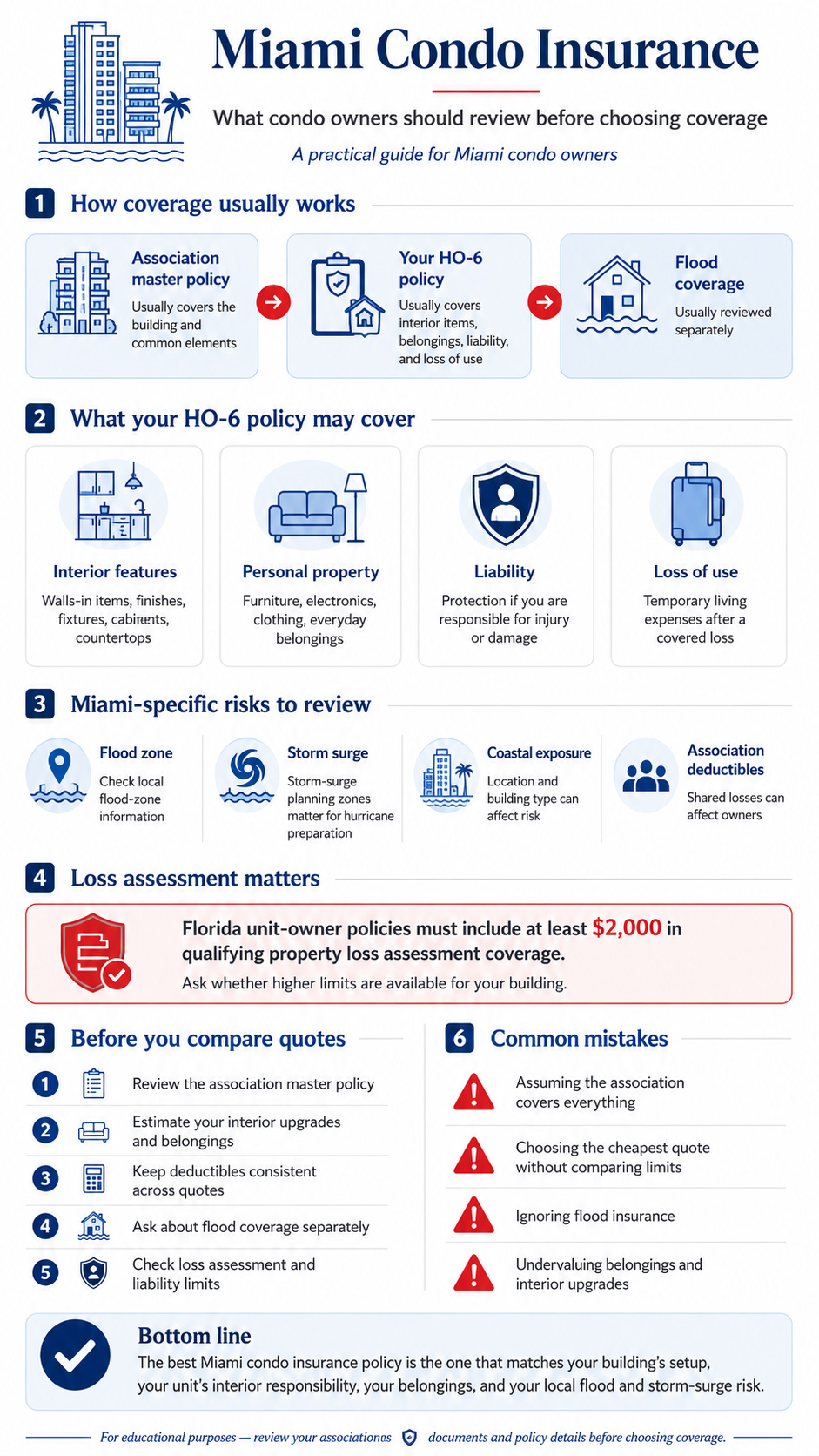
    Infographic explaining Miami condo insurance, including association master policy, HO-6 coverage, flood insurance, storm surge risk, loss assessment coverage, quote comparison steps, and common mistakes for condo owners.

    Why Miami condo insurance needs a local approach

    Miami condo ownership often involves risks and questions that are more specific than a simple statewide condo insurance explanation. A unit in Brickell, Downtown Miami, Edgewater, Miami Beach, Coconut Grove, Coral Gables, Sunny Isles, or another Miami-area market may involve different building age, elevation, association insurance limits, flood exposure, lender expectations, and interior improvement values. The policy should be built around the unit and the building, not only around a ZIP code.

    Miami-Dade County says FEMA’s digital flood hazard maps reflect current flood risks for the county and are used when determining flood insurance policy rates. The county also tells residents and businesses to use the maps to better understand potential flood risk and identify steps they may need to take to protect property. [1]

    Miami condo factor Why it matters What to review
    Flood zone Flood risk can affect lender requirements, flood policy decisions, and long-term ownership planning. Miami-Dade flood map tools and your insurance agent’s flood discussion.
    Storm-surge planning zone Storm surge planning affects hurricane preparation and evacuation decisions. Your Miami-Dade storm-surge planning zone.
    Association insurance The association’s policy affects what you need to insure yourself. Master policy certificate, declarations, bylaws, and insurance summary.
    High-rise or coastal exposure Building type, location, wind exposure, and association deductibles can change the coverage conversation. Building age, elevation, reserves, deductibles, and inspection/maintenance information.
    Interior improvements Remodeled flooring, cabinets, countertops, appliances, and fixtures may increase your needed limit. A room-by-room list of upgrades and finishes inside the unit.

    Miami condo insurance by area and building type

    A useful Miami condo insurance quote should reflect more than the word “Miami.” Building height, coastal exposure, bayfront location, association deductible structure, unit upgrades, occupancy type, and lender instructions can all change the questions you should ask before choosing coverage.

    Miami-area situation What may change the quote Question to ask before buying
    Brickell or Downtown high-rise High-rise association deductibles, interior upgrades, lender requirements, and loss assessment exposure. Does the master policy leave any deductible or assessment risk that your HO-6 policy should address?
    Miami Beach or coastal condo Flood discussion, storm-surge planning, wind exposure, and association flood coverage. Have you reviewed flood coverage separately from the standard HO-6 quote?
    Edgewater, bayfront, or waterfront building Building elevation, association insurance limits, flood-zone questions, and possible shared deductibles. Does the association carry flood coverage, and do you need separate contents flood coverage?
    Coconut Grove or Coral Gables unit Older building features, renovated interiors, custom finishes, and replacement-cost assumptions. Are flooring, cabinets, countertops, fixtures, and appliances properly reflected in the quote?
    Sunny Isles or luxury condo Higher-value personal property, upgraded finishes, association requirements, and larger loss assessment concerns. Are personal property, liability, and loss assessment limits high enough for the unit profile?

    Association master policy vs. your Miami HO-6 policy

    Florida condo owners should not assume that the association’s insurance solves everything. Florida Statute 718.111 says a residential condominium association must use its best efforts to maintain adequate property insurance for association property, common elements, and the condominium property the association must insure. The same statute also explains that association coverage must exclude personal property within the unit and several interior items such as floor, wall, and ceiling coverings, electrical fixtures, appliances, water heaters, built-in cabinets, countertops, and window treatments that are located within the unit and serve only that unit. Such property and the insurance on it are the unit owner’s responsibility. [2]

    That is why a Miami condo owner should read the association documents before choosing limits. If the unit has upgraded flooring, custom closets, built-in cabinets, renovated bathrooms, upgraded lighting, or higher-value appliances, the difference between association coverage and unit-owner responsibility can matter after a covered loss.

    Coverage layer Usually connected to Miami owner takeaway
    Association master policy Building property, common elements, and association-level insurance responsibilities. Use it to understand what the building insures before setting your personal limits.
    HO-6 unit-owner policy Interior responsibility, personal property, liability, loss of use, and loss assessment coverage. Use it to protect the parts of condo ownership that fall on you, not the association.
    Flood policy Flood damage to covered building property or contents, depending on the policy. Review separately because standard condo insurance usually does not cover flood.

    What HO-6 condo insurance can cover in Miami

    The Florida Office of Insurance Regulation describes HO-6 condo insurance as coverage for condominiums and notes that it is often called “walls-in” coverage because it covers the interior of the structure while the condo association’s master policy covers the exterior structure and common areas. FLOIR also states that HO-6 policies generally provide coverage for building property, personal property, personal liability, and loss of use. [3]

    Interior building property

    This can involve the parts of the unit that are your responsibility, such as certain interior finishes, built-ins, fixtures, cabinets, countertops, and improvements.

    Personal property

    Furniture, electronics, clothing, décor, kitchen items, small appliances, and everyday belongings should be estimated realistically before choosing a limit.

    Personal liability

    Liability coverage may help if you are responsible for injury or property damage involving someone else.

    Loss of use

    Loss of use can help with additional living expenses if a covered loss makes your condo temporarily unlivable.

    Flood insurance and storm surge in Miami

    Flood is one of the most important issues for Miami condo owners because standard condo insurance and flood insurance are not the same thing. FLOIR states that HO-6 policies usually do not cover flooding and that additional coverage needs to be purchased if flood insurance is desired. FloodSmart also explains that most homeowners and renters insurance does not cover flood damage, and that NFIP flood policies are available for homeowners, including people who own condominiums and townhouses in participating NFIP communities. [4] [5]

    Miami-Dade County also explains that storm surge is the greatest threat to life and property from a hurricane and that storm-surge planning zones are used for evacuation decisions. The county says these zones are separate from flood zones, which means Miami condo owners should not treat a flood-zone check and a storm-surge planning check as the same thing. [6]

    Miami flood and storm-surge checklist
    • Check the unit’s flood zone before assuming the standard HO-6 policy is enough.
    • Review whether the association carries flood coverage for the building.
    • Ask whether you need contents flood coverage for belongings inside the unit.
    • Check your storm-surge planning zone separately from your flood zone.
    • Confirm any flood requirements tied to your mortgage lender.

    Loss assessment coverage matters in Miami condo buildings

    Loss assessment coverage can matter when a condominium association assesses owners after certain shared property losses, association deductibles, or covered building-level events. Florida Statute 627.714 states that unit owner residential property policies issued or renewed on or after July 1, 2010 must include at least $2,000 in property loss assessment coverage for qualifying assessments made as a result of the same direct loss to property, when the loss is of the type covered by the unit owner’s residential property insurance policy. [7]

    The minimum amount is not automatically the right amount for every Miami condo owner. A large coastal building, a high association deductible, older construction, limited reserves, or a major covered loss can make assessment risk more serious. Owners should ask whether higher loss assessment limits are available, what deductible applies, and which types of assessments are excluded.

    Questions to ask about loss assessment
    • What is the policy’s loss assessment limit?
    • Can the limit be increased?
    • Does the coverage apply to association deductibles after a covered property loss?
    • Is there a separate deductible for loss assessment coverage?
    • Which assessments are not covered?

    Miami condo quote factors to compare side by side

    The strongest Miami condo quote is not always the quote with the lowest first premium. Compare each option using the same assumptions so one policy is not cheaper only because it has weaker limits, higher deductibles, or missing coverage questions.

    Quote factor Why it matters in Miami Compare this carefully
    Interior building property Renovated units may have higher-value flooring, cabinets, fixtures, and appliances. Use the same interior limit when comparing quotes.
    Personal property A high-rise or seasonal unit can still contain expensive belongings. Compare contents limits and replacement-cost options.
    Deductibles Wind, hurricane, and all-other-perils deductibles can affect the real cost after a claim. Compare deductible type, amount, and percentage carefully.
    Loss assessment Shared building losses and association deductibles can affect unit owners. Ask what limit is included and whether it can be increased.
    Flood question Standard HO-6 coverage usually does not solve flood damage. Check building flood coverage, contents flood needs, and lender requirements.

    Miami condo insurance before closing

    Miami condo buyers should not wait until the last week before closing to review insurance. A lender or title company may request proof of coverage, mortgagee wording, minimum limits, flood information, or confirmation that the association carries certain coverage. The fastest way to avoid delays is to gather documents before choosing an HO-6 quote.

    Before-closing checklist for Miami condo buyers
    • Ask the association or property manager for the certificate of insurance.
    • Review the declaration, bylaws, and deductible information before setting HO-6 limits.
    • Confirm whether the lender requires flood insurance or specific mortgagee wording.
    • Estimate personal property and interior upgrades before accepting a low quote.
    • Ask about loss assessment coverage and whether higher limits are available.
    Review the full condo insurance before closing guide

    Documents to review before comparing Miami condo insurance quotes

    A Miami condo quote is much easier to evaluate when you know what the building already insures and what you personally need to cover. Before choosing a policy, ask for the association’s insurance certificate, declarations page if available, bylaws, condominium declaration, budget or reserve information, deductible information, and any lender-specific insurance requirements.

    Document or detail Why it helps
    Association certificate of insurance Shows the main policies and limits the association currently carries.
    Condo declaration and bylaws Helps clarify what belongs to the association and what belongs to the unit owner.
    Master policy deductible information Helps you understand whether association deductibles could create assessment concerns.
    Flood zone and storm-surge zone Helps frame the flood and hurricane-preparedness conversation.
    Interior upgrade list Helps set realistic limits for building property and personal belongings.

    How to compare Miami condo insurance quotes

    Many Miami condo owners compare quotes by premium first, but that can be misleading. A cheaper quote may simply use lower personal property limits, weaker loss assessment coverage, higher deductibles, limited water backup protection, or a different assumption about what is covered inside the unit. For a fair comparison, keep the major limits and deductibles as close as possible before deciding which option is better.

    For broader statewide context, review our Condo Insurance in Florida guide. For a policy-type explanation, use our Florida HO6 Insurance page. For lender, association, and owner-responsibility questions, review Florida Condo Insurance Requirements. Once you are ready to compare options, continue with our Florida Condo Insurance Quotes guide.

    Miami quote comparison method
    1. Review the association master policy before choosing your HO-6 limits.
    2. Estimate your personal property and interior improvements separately.
    3. Compare hurricane, wind, and all-other-perils deductibles carefully.
    4. Ask about loss assessment, water backup, liability, and loss of use.
    5. Review flood insurance separately from the standard condo policy.
    6. Check lender requirements before accepting the lowest premium.

    Common mistakes Miami condo owners should avoid

    • Assuming the association’s master policy covers everything inside the condo.
    • Ignoring flood insurance because the unit is above ground level.
    • Confusing flood zones with storm-surge planning zones.
    • Choosing the cheapest quote without comparing deductibles and limits.
    • Forgetting to review loss assessment coverage.
    • Undervaluing personal belongings and interior upgrades.
    • Waiting until closing or renewal week to ask for association insurance documents.
    • Assuming every Miami condo building creates the same insurance need.

    Where to go next

    If price is your main concern, compare this page with our Cheapest Condo Insurance in Florida guide. If you want a broader value comparison, use Best Condo Insurance in Florida. If you are deciding between carriers or agency options, review Florida Condo Insurance Companies before requesting quotes.

    FAQ: Miami condo insurance

    Is condo insurance required in Miami?

    Many Miami condo owners need HO-6 coverage because of lender requirements, association documents, or practical financial protection. Even when a specific owner is not forced to buy a policy in the same way as another owner, coverage can still be important for interior property, belongings, liability, loss of use, and loss assessment exposure.

    Does the condo association policy cover my Miami unit?

    The association policy may cover building-level property and common elements, but it usually does not cover your personal belongings, liability, temporary living expenses, or many interior items that serve only your unit. Review the association documents before deciding your limits.

    Does Miami condo insurance cover flood damage?

    Standard HO-6 condo insurance usually does not cover flood damage. Miami condo owners should review flood coverage separately, check whether the association carries flood insurance for the building, and ask whether they need contents flood coverage for their personal property.

    What is loss assessment coverage for a Miami condo owner?

    Loss assessment coverage can help when a condo association assesses unit owners after certain covered property losses. Florida requires at least $2,000 in qualifying property loss assessment coverage in unit owner residential property policies, but some owners may want to ask about higher limits.

    How much Miami condo insurance should I buy?

    The right amount depends on your association’s insurance setup, your interior responsibility, your personal property value, your deductible comfort, your loss assessment exposure, your lender requirements, and whether you need separate flood coverage.

    What should I prepare before closing on a Miami condo?

    Ask for the association certificate of insurance, master policy deductible details, condo declaration, bylaws, lender insurance instructions, flood-zone information, and a list of interior upgrades before accepting a quote. This helps the HO-6 policy match the building, lender, and unit details.

    Should Miami Beach and Brickell condo owners compare coverage differently?

    They should ask more detailed location and building questions. A coastal or high-rise condo may raise different flood, wind, deductible, association, and lender concerns than a smaller inland building. The policy should reflect the actual unit and building, not only the city name.

    Bottom line

    Miami condo insurance works best when it is treated as a building-specific and unit-specific decision. The right policy should reflect what the association insures, what you are responsible for inside the unit, how much your belongings and upgrades are worth, whether loss assessment coverage is strong enough, and whether flood insurance needs to be handled separately.

    A low premium may look attractive, but the better question is whether the quote would still make sense after a real Miami loss scenario. Review the documents, compare limits carefully, ask the flood question early, and choose coverage that fits the unit instead of relying only on the cheapest number.

    Next step

    Compare Miami condo insurance options after you understand your association policy, HO-6 needs, deductible exposure, flood question, lender requirements, and loss assessment risk.

    Compare Miami Condo Insurance Quotes

    References

    1. Miami-Dade County, “Flood Zone Maps.” Source ·
    2. Florida Statutes, Section 718.111, “The association — Insurance.” Source ·
    3. Florida Office of Insurance Regulation, “Homeowners Insurance — HO-6 Condo Form.” Source ·
    4. Florida Office of Insurance Regulation, “Homeowners Insurance — HO-6 flood note.” Source ·
    5. FEMA FloodSmart, “What you need to know about buying flood insurance.” Source ·
    6. Miami-Dade County, “Storm Surge Planning Zones.” Source ·
    7. Florida Statutes, Section 627.714, “Residential condominium unit owner coverage; loss assessment coverage required.” Source ·