
By FloridaCondoInsurance.com Editorial Team
Published on · Updated on
About this review
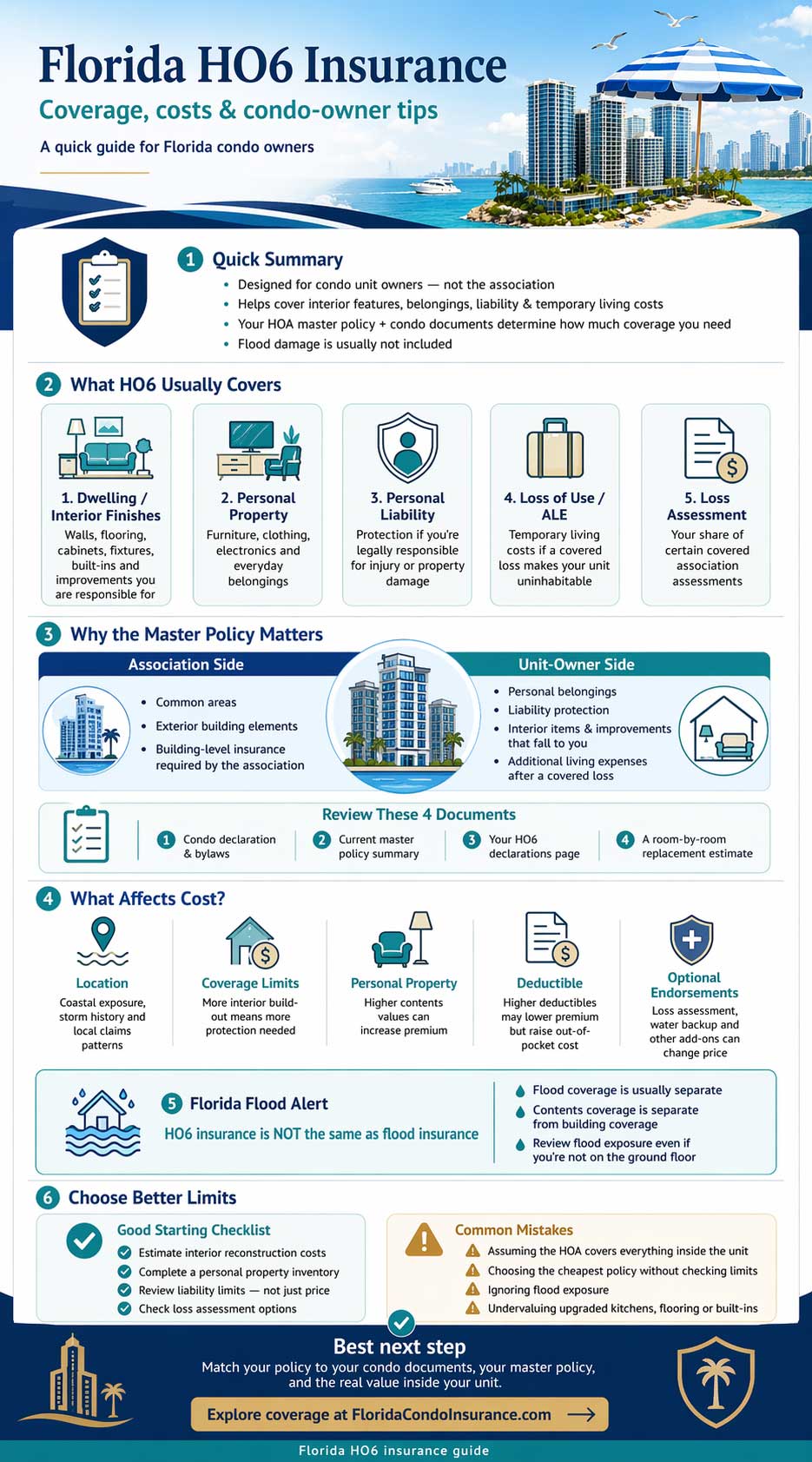
Florida HO-6 insurance is the condo unit-owner policy that helps protect the part of condominium ownership that belongs to you. It is not the same as the association master policy, it is not a standard homeowners policy, and it is not a flood insurance policy. For many Florida condo owners, HO-6 coverage is the policy that may respond to interior unit property, personal belongings, personal liability, additional living expenses, and certain loss assessment situations after a covered loss.
The Florida Office of Insurance Regulation describes HO-6 condo insurance as coverage for condominiums and notes that it is often called “walls-in” coverage because it generally covers the interior of the structure while the condo association’s master policy covers the exterior structure and common areas. FLOIR also says HO-6 policies generally provide coverage for building property, personal property, personal liability, and loss of use, and that HO-6 usually does not cover flooding. [1]
- HO-6 insurance is designed for condo unit owners, not condominium associations.
- The association master policy and the unit-owner HO-6 policy usually insure different responsibilities.
- Coverage A, Coverage C, liability, loss of use, loss assessment, and water backup should be reviewed separately.
- Flood insurance is a separate decision because standard HO-6 coverage usually does not cover flood damage.
- The right HO-6 limit depends on the condo documents, interior upgrades, belongings, lender requirements, deductibles, and association insurance setup.
Florida HO-6 insurance in plain English
HO-6 insurance is the policy most commonly associated with condominium unit-owner coverage. A simple way to understand it is this: the association may insure the building and common property, while your HO-6 policy may insure your side of ownership. That can include the parts of the unit you are responsible for, your belongings, your personal liability, temporary living expenses after a covered loss, and certain assessments charged by the association.
The exact answer depends on your policy, endorsements, exclusions, association documents, deductible structure, lender requirements, and Florida law. That is why HO-6 insurance should not be chosen only by price. A lower quote may have weaker interior building property limits, lower personal property coverage, higher deductibles, actual cash value instead of replacement cost, limited loss assessment protection, no water backup endorsement, or no separate flood solution.
What HO-6 is not
One reason HO-6 coverage causes confusion is that people often compare it to other types of property insurance. A Florida condo owner should separate HO-6 from the association policy, standard homeowners insurance, renters insurance, and flood insurance before comparing quotes.
HO-6 policy vs. association master policy
The most important HO-6 question is where the association’s responsibility ends and your responsibility begins. Florida Statute 718.111 says a condominium association must use its best efforts to obtain and maintain adequate property insurance for association property, common elements, and condominium property the association is required to insure. The statute also excludes personal property within the unit and certain interior items located within the unit and serving only that unit, including floor, wall and ceiling coverings, electrical fixtures, appliances, water heaters, built-in cabinets, countertops, and window treatments. [2]
What Florida HO-6 insurance may cover
HO-6 coverage is often reviewed through specific coverage parts. The names and limits can vary by company, but most Florida condo owners should pay attention to interior building property, personal property, personal liability, loss of use, medical payments to others, loss assessment, and optional endorsements.
Real examples of when HO-6 may or may not help
The easiest way to understand HO-6 insurance is to test common condo loss scenarios. These examples are general and depend on the policy, cause of loss, exclusions, deductible, association documents, and who is legally responsible for the damaged property.
What HO-6 insurance usually does not solve by itself
A strong HO-6 policy still has limits and exclusions. Florida condo owners should not treat it as a complete solution for every possible condo-related loss. Flood damage, long-term maintenance, uncovered assessments, wear and tear, association disputes, and high-value property limits may require separate review.
Flood damage
FLOIR states that HO-6 usually does not cover flooding. Flood insurance should be reviewed separately.
Maintenance problems
Insurance is not a substitute for maintenance, repairs, routine wear and tear, or association upkeep responsibilities.
Unscheduled valuables
Jewelry, collectibles, electronics, and other high-value property may have special limits or may need scheduling.
Loss assessment coverage in Florida HO-6 policies
Loss assessment coverage deserves special attention in Florida because a condominium association may assess owners after certain shared losses or association-level deductibles. Florida Statute 627.714 states that residential condominium unit owner policies issued or renewed on or after July 1, 2010 must include at least $2,000 in property loss assessment coverage for qualifying assessments made as a result of the same direct property loss, when the loss is of the type covered by the unit owner’s residential property insurance policy. [3]
- What loss assessment limit is included in the HO-6 quote?
- Can the limit be increased beyond the statutory minimum?
- Does the coverage apply to association deductibles after a covered property loss?
- Is there a separate deductible for loss assessment coverage?
- Which assessments are excluded?
- Does the policy treat owner-caused losses differently?
- Does the association have a large wind, hurricane, or all-other-perils deductible?
Flood insurance and HO-6 coverage are not the same thing
Flood insurance should be reviewed separately from a standard HO-6 policy. FloodSmart explains that homeowners in participating NFIP communities, including people who own condominiums and townhouses, can buy flood insurance. FloodSmart also states that building policies can cover up to $250,000 of flood damage and contents policies can cover up to $100,000 for belongings kept inside the home. [4]
- Does the association carry a flood policy for the building?
- Does the association flood policy protect your belongings or only building property?
- Do you need contents flood coverage?
- Does your lender require flood insurance?
- Are NFIP and private flood options available for your unit?
- Does the policy distinguish between flood damage and water backup?
- Does your condo sit in a mapped flood zone or an area with drainage concerns?
Replacement cost vs. actual cash value
Personal property coverage should be reviewed with the claim-payment method in mind. Replacement cost coverage generally aims to replace covered property with new items of like kind and quality, while actual cash value usually reflects depreciation. A cheaper HO-6 policy may look attractive but pay less after a covered loss if belongings are insured on an actual-cash-value basis.
Named perils vs. open perils in HO-6 coverage
HO-6 policy forms can differ in how covered losses are defined. FLOIR notes that condo insurance usually uses a named-peril policy, but some insurers may allow coverage to be extended to an open-peril policy for a higher premium. That difference can matter because one HO-6 quote may not cover the same causes of loss as another. [1]
- Which causes of loss are covered for interior building property?
- Which causes of loss are covered for personal property?
- Are water backup, hidden water damage, or equipment-related water issues excluded or optional?
- Are hurricane, wind, and all-other-perils deductibles different?
- Are there special limits for jewelry, electronics, collectibles, or business property?
- Is personal property covered at replacement cost or actual cash value?
How to read an HO-6 declarations page
The declarations page is the summary page of the policy. It does not replace the full policy, but it helps you quickly compare important limits and deductibles. When comparing HO-6 quotes, review the same sections side by side instead of comparing only the final premium.
How to choose Florida HO-6 limits
Choosing HO-6 limits should start with documents, not guesswork. Your condo declaration, bylaws, association insurance certificate, master policy summary, deductible schedule, lender requirements, and list of upgrades all help determine how much coverage may be appropriate. The goal is to match the policy to what you would actually have to repair, replace, or pay after a covered loss.
Documents to review before buying or renewing HO-6 insurance
A Florida HO-6 quote is only as good as the information behind it. Before choosing coverage, gather the documents that show what the association insures, what you must insure, what your lender expects, and what the policy actually covers.
Association documents
- Certificate of insurance
- Master policy summary if available
- Declaration and bylaws
- Deductible schedule
- Flood policy information if available
- Reserve or assessment information if available
Unit-owner details
- Interior upgrade list
- Personal property inventory
- Current declarations page if insured
- Preferred deductible range
- Lender requirements
- Occupancy or rental-use details
Policy items
- Coverage A limit
- Coverage C limit
- Liability limit
- Loss assessment limit
- Water backup endorsement
- Replacement cost option
Common Florida HO-6 insurance mistakes
- Assuming the association covers everything inside the unit.
- Choosing the cheapest quote without comparing limits, deductibles, and exclusions.
- Ignoring loss assessment coverage or leaving the minimum unchanged without review.
- Assuming HO-6 coverage includes flood insurance.
- Confusing water backup coverage with flood insurance.
- Undervaluing flooring, cabinets, fixtures, appliances, and built-ins.
- Choosing personal property limits without making a basic inventory.
- Not checking replacement cost versus actual cash value.
- Not asking whether special limits apply to jewelry, electronics, collectibles, or business property.
- Waiting until closing week or renewal week to request association documents.
- Comparing two HO-6 quotes without matching Coverage A, Coverage C, loss assessment, and deductibles.
How HO-6 fits into your broader Florida condo insurance plan
HO-6 insurance is the unit-owner policy, but it is not the entire insurance picture. Florida condo owners should also understand the association master policy, flood insurance options, lender requirements, and whether the building’s deductibles or shared losses could affect individual owners.
For the broader statewide framework, review our Condo Insurance in Florida guide. If you are comparing policy options, use our Florida Condo Insurance Quotes page. You can also review related rules in our Florida Condo Insurance Requirements guide or compare broader options through our Florida Condo Insurance Companies page.
FAQ: Florida HO-6 insurance
Is HO-6 insurance required in Florida?
Florida law, association documents, and lender requirements can all affect the answer. Even when a specific unit owner is not required in the same way as another owner, HO-6 coverage can still be important for interior property, belongings, liability, loss of use, and loss assessment exposure.
What is the difference between HO-6 and condo insurance?
HO-6 is the policy form commonly used for condo unit-owner insurance. People often use “HO-6 insurance” and “condo insurance” to describe the same unit-owner coverage, but the exact protection depends on the policy, endorsements, exclusions, and association documents.
Does HO-6 cover the outside of the condo building?
Usually no. The association master policy is generally connected to the building exterior, common elements, and association-level property. The HO-6 policy is focused on the unit owner’s side of the insurance arrangement.
Does HO-6 insurance cover flood damage?
Standard HO-6 insurance usually does not cover flood damage. Flood insurance should be reviewed separately, and condo owners should ask whether the association carries flood coverage for the building and whether contents flood coverage is needed.
What is loss assessment coverage on an HO-6 policy?
Loss assessment coverage can help when a condominium association assesses owners after certain covered property losses. Florida requires qualifying unit-owner residential property policies to include at least $2,000 in property loss assessment coverage, but some owners may want to ask about higher limits.
Does HO-6 cover water damage from inside the unit?
It depends on the cause of the water damage, the policy language, exclusions, deductible, maintenance facts, and who is responsible for the damaged property. Water backup and flood damage are different coverage questions, so both should be reviewed separately.
How much HO-6 coverage should I buy?
Start with your association documents, then estimate your interior responsibility, personal property, liability needs, loss of use needs, loss assessment exposure, flood exposure, and deductible comfort. The right amount depends on your unit, building, lender, and risk tolerance.
Should I choose the cheapest HO-6 quote?
Not without comparing the coverage. A cheaper quote may use lower limits, higher deductibles, actual cash value instead of replacement cost, weak loss assessment coverage, or missing endorsements. Compare the policy details before relying on the premium.
Bottom line
Florida HO-6 insurance should be built around your actual unit-owner responsibilities. The right approach is to review the association master policy, declaration, bylaws, deductible information, lender requirements, interior upgrades, personal property, loss assessment exposure, water backup needs, and flood insurance needs before choosing limits.
A good HO-6 policy is not just the cheapest option. It is the policy that fits what you own, what the association does not cover, what your lender requires, and what you could afford to pay after a covered loss.
After you understand HO-6 coverage, compare Florida condo insurance quotes using the same deductibles, interior property limits, personal property assumptions, liability limits, loss assessment needs, and flood insurance questions.
References
-
Florida Office of Insurance Regulation, “Homeowners Insurance.”
Source
·
↩
-
Florida Statutes, Section 718.111, “The association — Insurance.”
Source
·
↩
-
Florida Statutes, Section 627.714, “Residential condominium unit owner coverage; loss assessment coverage required.”
Source
·
↩
-
FEMA FloodSmart, “What you need to know about buying flood insurance.”
Source
·
↩